At the Museum für Gestaltung Zürich, the Dutch-New Zealand designer transforms fifteen years of material experimentation into an immersive exploration of light, colour and perception.
Light has always occupied a central position in Sabine Marcelis’ practice. Rather than treating it as a means of illuminating objects, the Rotterdam-based designer approaches it as a material in its own right, capable of transforming surfaces, altering spatial relationships and challenging the boundaries between the physical and the perceptual.
At the Museum für Gestaltung Zürich, Sabine Marcelis – Light and Color brings together fifteen years of experimentation in the designer’s first dedicated museum exhibition. Curated by Damian Fopp, the presentation traces the evolution of a practice that moves fluidly between product design, sculpture, architecture and immersive installation.
Since establishing her studio in 2011, Marcelis has developed a distinctive visual language characterised by geometric simplicity, translucent materials and an almost architectural understanding of colour. Working primarily with resin, glass and reflective surfaces, she investigates how industrial processes can generate unexpected sensory experiences.
Yet the exhibition is less concerned with presenting a chronological overview than with revealing the processes behind her work. Material studies, experiments and finished objects are brought into dialogue, offering an insight into the decisions through which seemingly simple forms acquire their visual complexity.
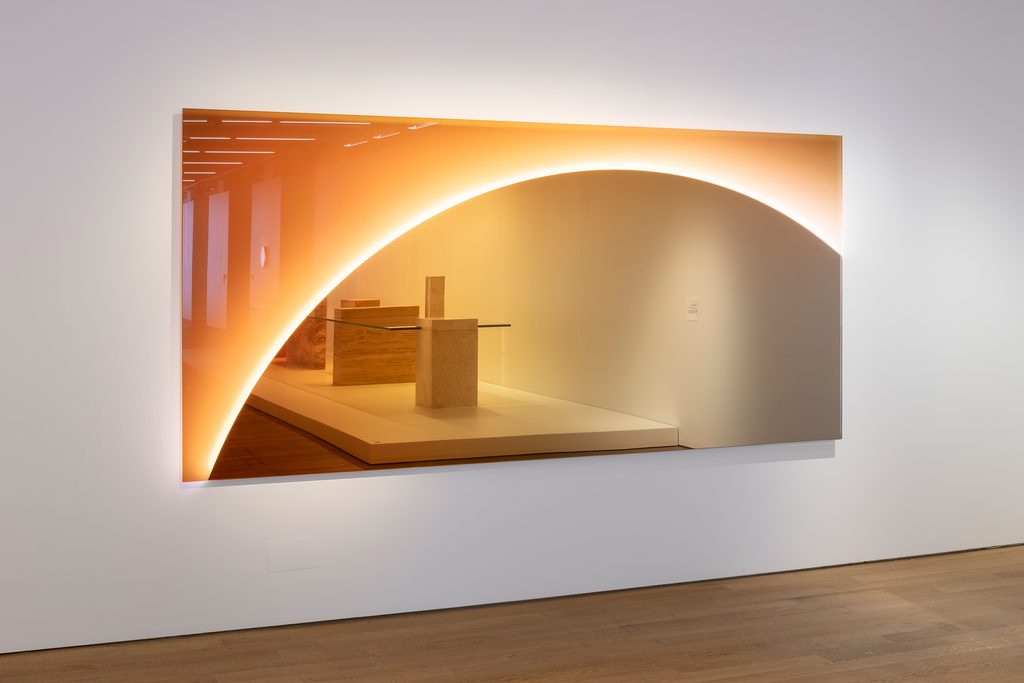
The exhibition unfolds through a sequence of environments that alternate between individual works and immersive spatial interventions. Rather than remaining passive objects of observation, Marcelis’ designs become elements through which visitors experience changes in light, colour and perspective.
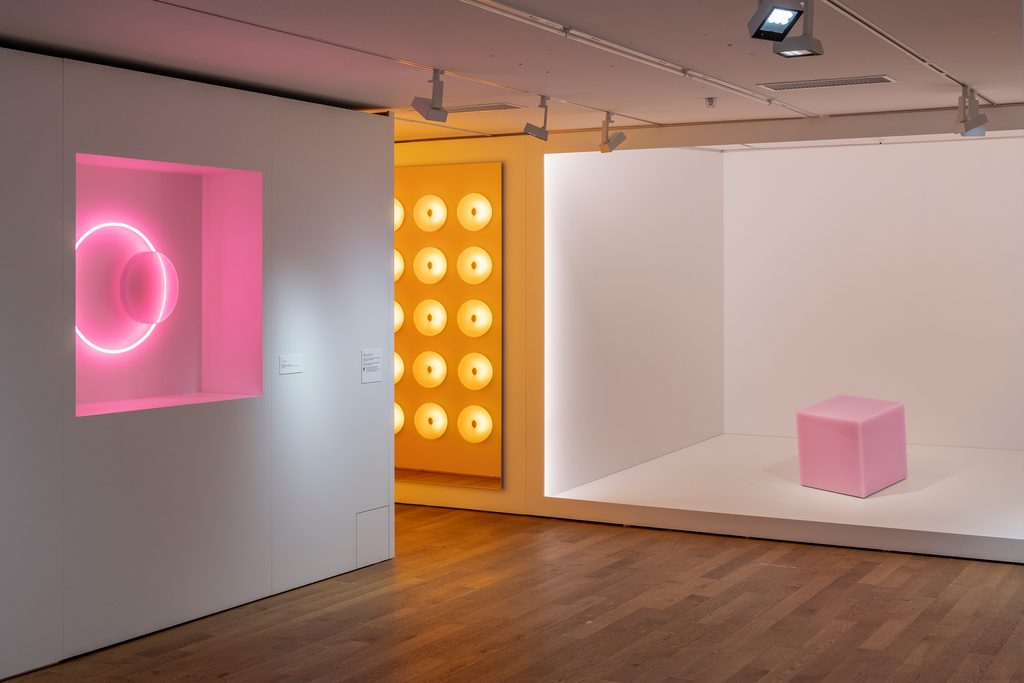
Among the works presented are Tall Stripe, the Candy Cube series and Sunbeam Capture, developed in collaboration with artist Boris Acket. Together, they illustrate the breadth of Marcelis’ research, from the manipulation of translucent materials to the relationship between natural phenomena and constructed environments.
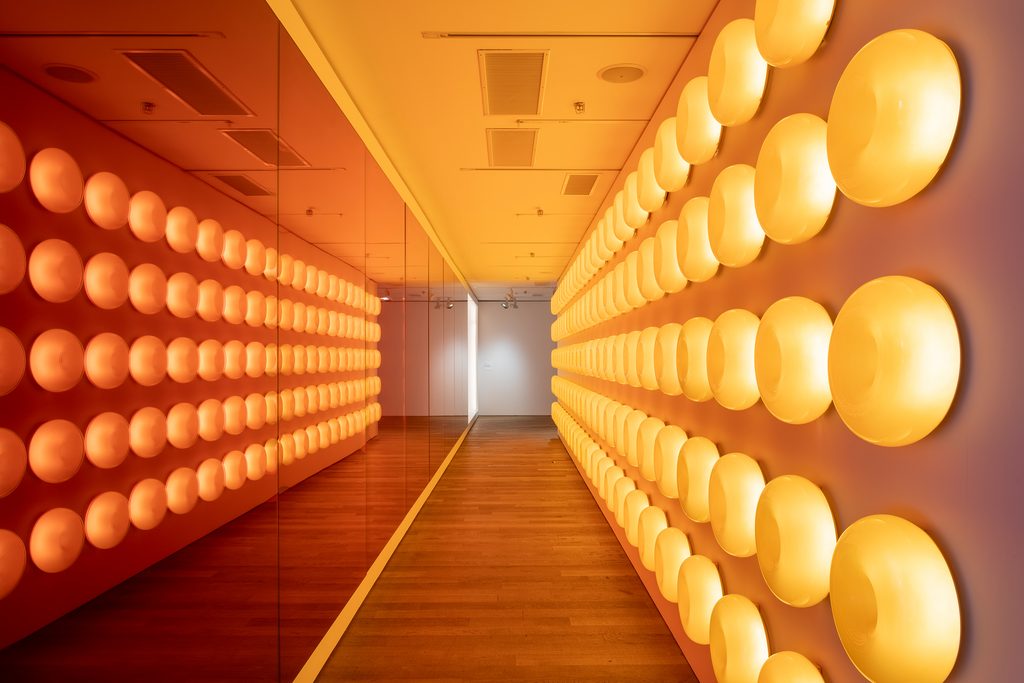
A particularly striking element is the light tunnel developed through Marcelis’ collaboration with IKEA Switzerland. Using lamps from the VARMBLIXT collection, the installation creates an illusion of infinite space through carefully orchestrated reflections.
Elsewhere, Mathmos Lava Columns, a site-specific installation featuring monumental floor-to-ceiling lava lamps, introduces movement into the exhibition. The changing forms of illuminated liquid, multiplied through mirrored surfaces, blur the boundaries of the surrounding architecture.
These installations reveal an important dimension of Marcelis’ practice: her interest in how design can influence not only the appearance of an environment, but also the way it is perceived and inhabited.
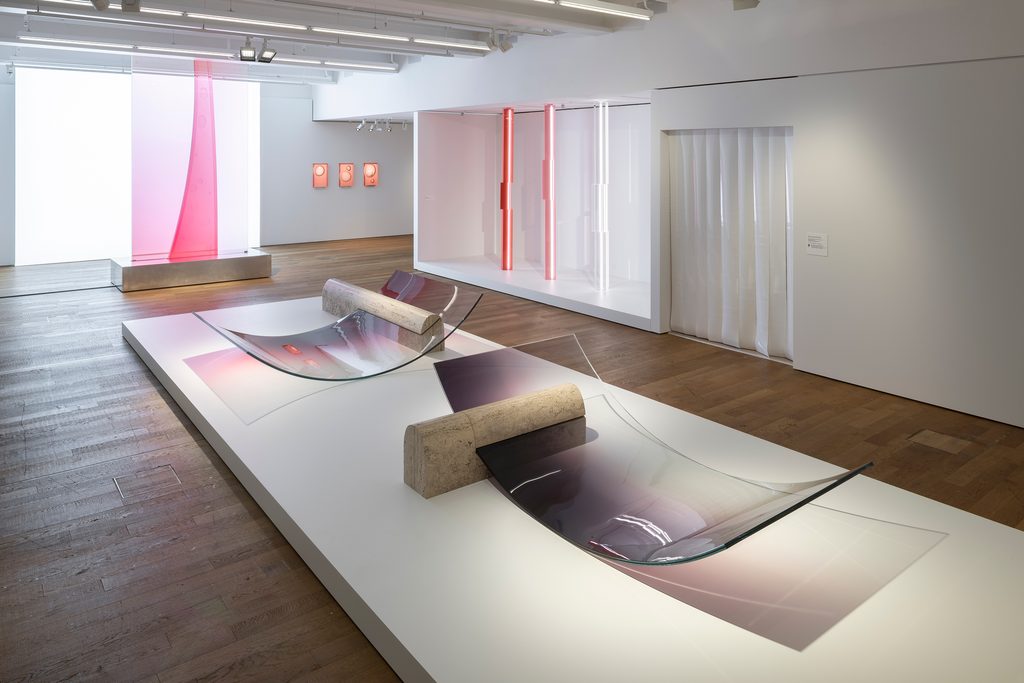
At the heart of Marcelis’ work lies a fascination with the relationship between material properties and visual perception.
Transparency, reflection and luminosity are not merely aesthetic effects. They become instruments through which familiar materials acquire unfamiliar qualities. A solid surface can appear almost weightless, while colour seems to extend beyond the physical limits of an object.
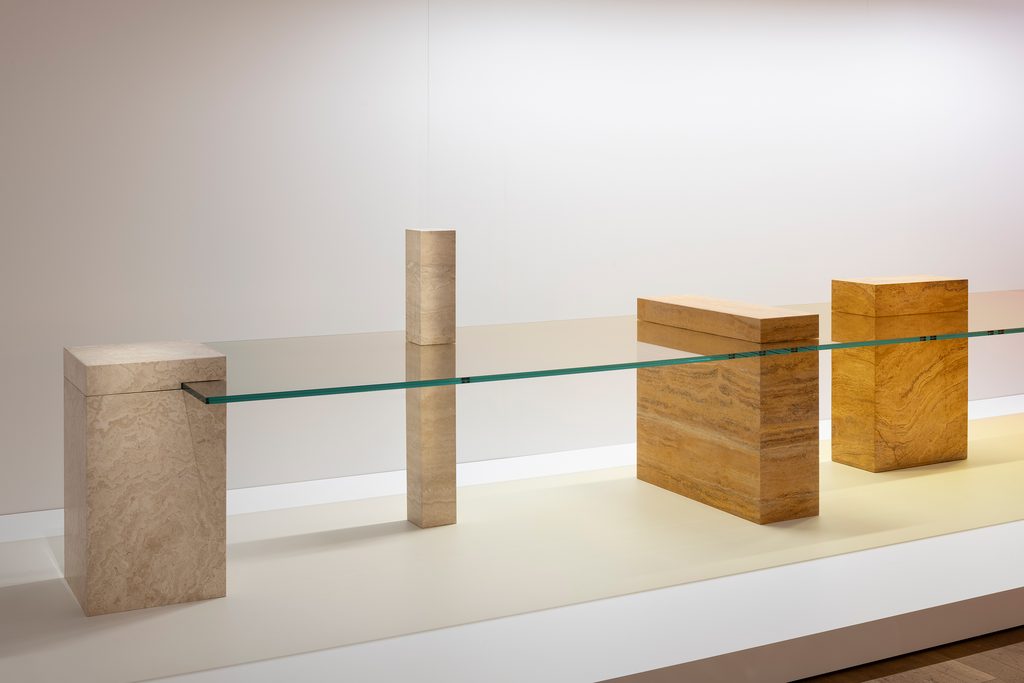
This approach is particularly evident in Marcelis’ use of resin and glass, materials whose visual characteristics change according to lighting conditions, viewing angles and their surrounding environments.
The exhibition scenography, developed by Studio Sabine Marcelis, reinforces these ideas through a restrained architectural language. Geometric elements, carefully positioned lighting and an emphasis on materiality establish a setting in which objects and space remain closely connected.
The result is an exhibition that moves beyond the conventional distinction between functional design and artistic experimentation. Marcelis’ work suggests that an object’s purpose cannot always be separated from the sensory experience it produces.
Marcelis belongs to a generation of designers increasingly interested in the experiential possibilities of objects and environments. Her practice operates across different scales, from limited-edition pieces and industrial collaborations to large-scale installations.
What connects these different approaches is a consistent investigation into the ways materials interact with light and how those interactions shape our understanding of space.
At the Museum für Gestaltung Zürich, this investigation becomes the exhibition’s central narrative. Rather than presenting design as a collection of finished products, Light and Color invites visitors to consider the processes, experiments and perceptual effects through which objects acquire meaning.
In doing so, Marcelis offers a perspective on contemporary design in which colour becomes spatial, light acquires material presence and perception itself emerges as an essential part of the creative process.
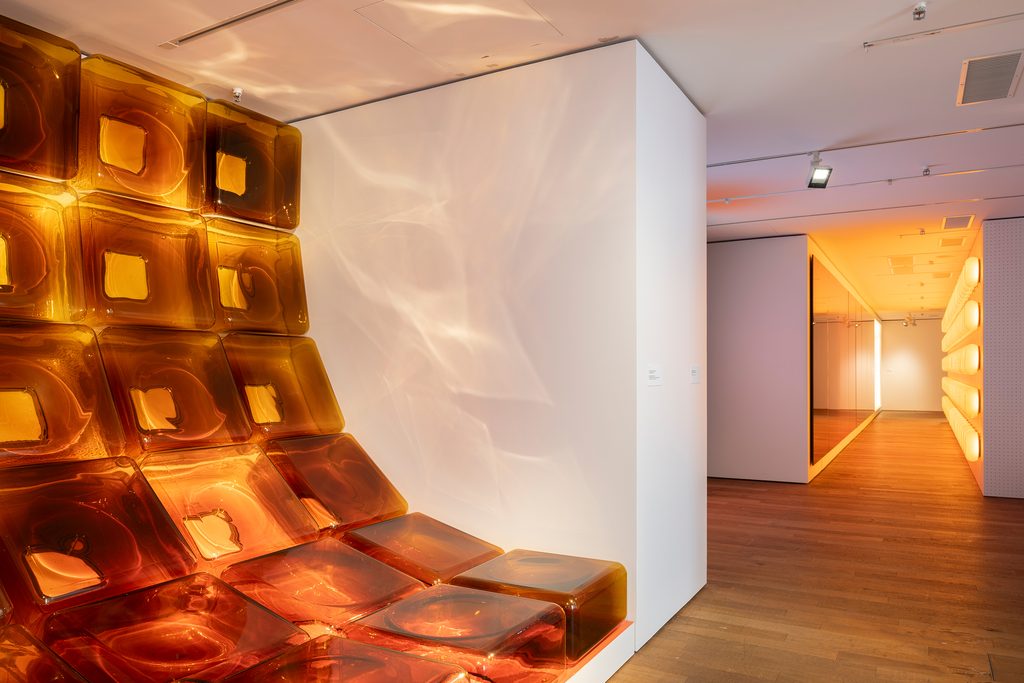
Sabine Marcelis – Light and Color
Museum für Gestaltung Zürich/ZHdK
October 30, 2026 – April 4, 2027
Curated by Damian Fopp.
Credit: Museum für Gestaltung Zürich/ZHdK
SABINE MARCELIS
is a Dutch-New Zealand designer based in Rotterdam. A graduate of Design Academy Eindhoven, she founded her studio in 2011. Working across product design, installations and interiors, her practice explores the relationship between light, colour and materiality. Through a distinctive use of resin, glass and reflective surfaces, Marcelis creates objects and environments that challenge conventional perceptions of form and space.