At the Bourse de Commerce, The History of Tears transforms Tadao Ando’s architecture into an immersive confrontation with language, power and the mechanisms that shape contemporary society.
Words have always been Barbara Kruger’s most powerful weapon. For decades, the American artist has appropriated the visual language of advertising, mass media and consumer culture to expose the structures of power embedded in everyday communication. Now, her unmistakable vocabulary takes over one of Paris’s most distinctive exhibition spaces.
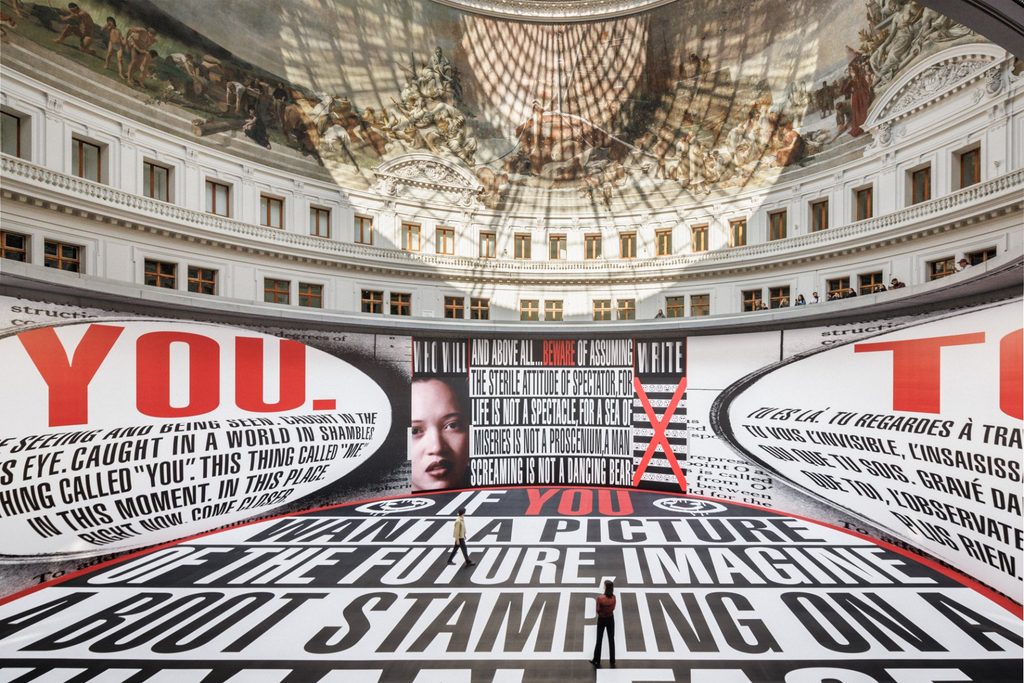
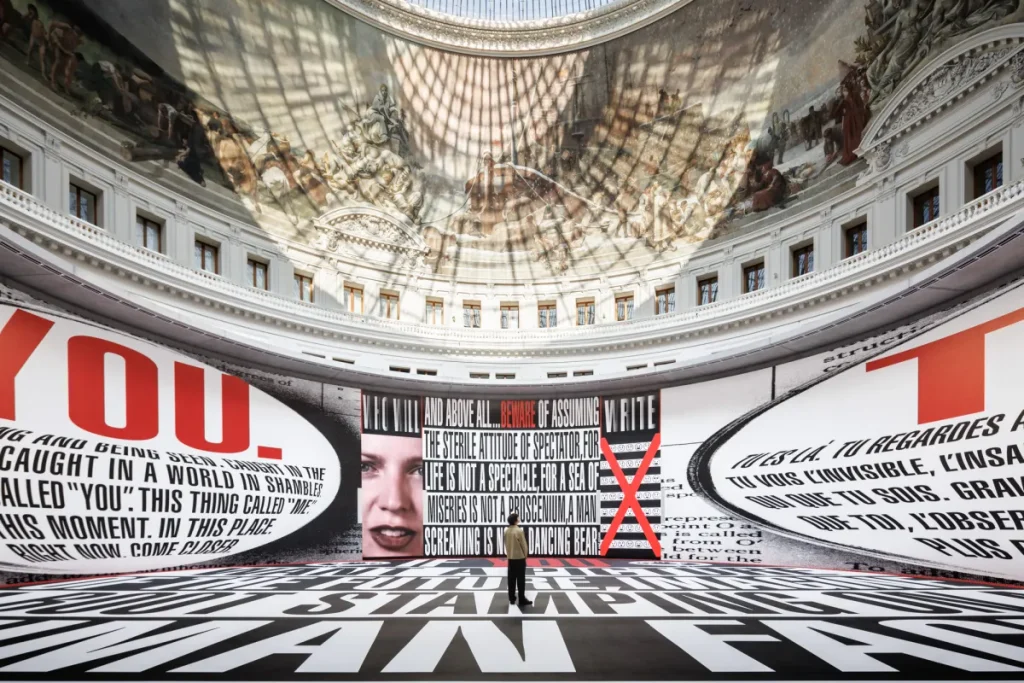
Presented by the Pinault Collection at the Bourse de Commerce, The History of Tears transforms the museum’s monumental Rotunda and its twenty-four surrounding display cases into an immersive environment of language, moving images and sound. Conceived specifically for the building, the exhibition extends Kruger’s investigation into the relationship between representation, desire, domination and the construction of collective identities.
At the centre of the installation is the architecture itself. The curved concrete walls designed by Tadao Ando become an expansive surface for monumental texts, including passages drawn from George Orwell’s 1984 and Aimé Césaire’s Notebook of a Return to the Native Land. Removed from the conventional space of the printed page, these literary references acquire a physical presence, confronting visitors with questions of political authority, oppression and resistance.
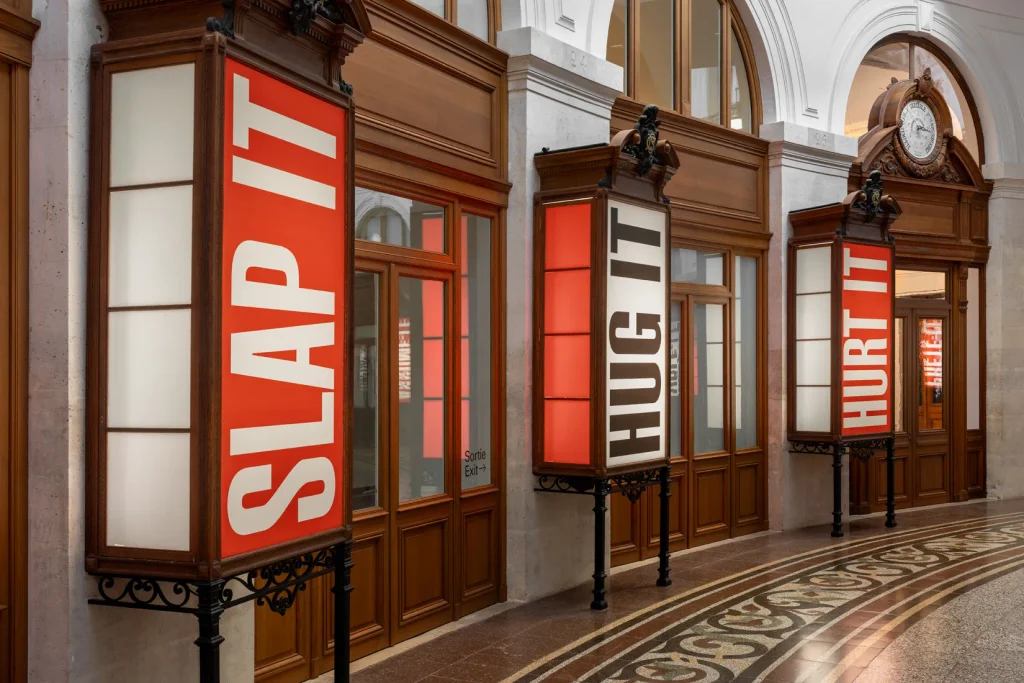
Beyond the Rotunda, the museum’s twenty-four display cases have been transformed into illuminated structures carrying Kruger’s characteristically direct messages. Language becomes inseparable from the architecture, surrounding the viewer rather than remaining confined to individual artworks. The result is an environment in which reading becomes a spatial experience and the distinction between image, text and exhibition space begins to dissolve.
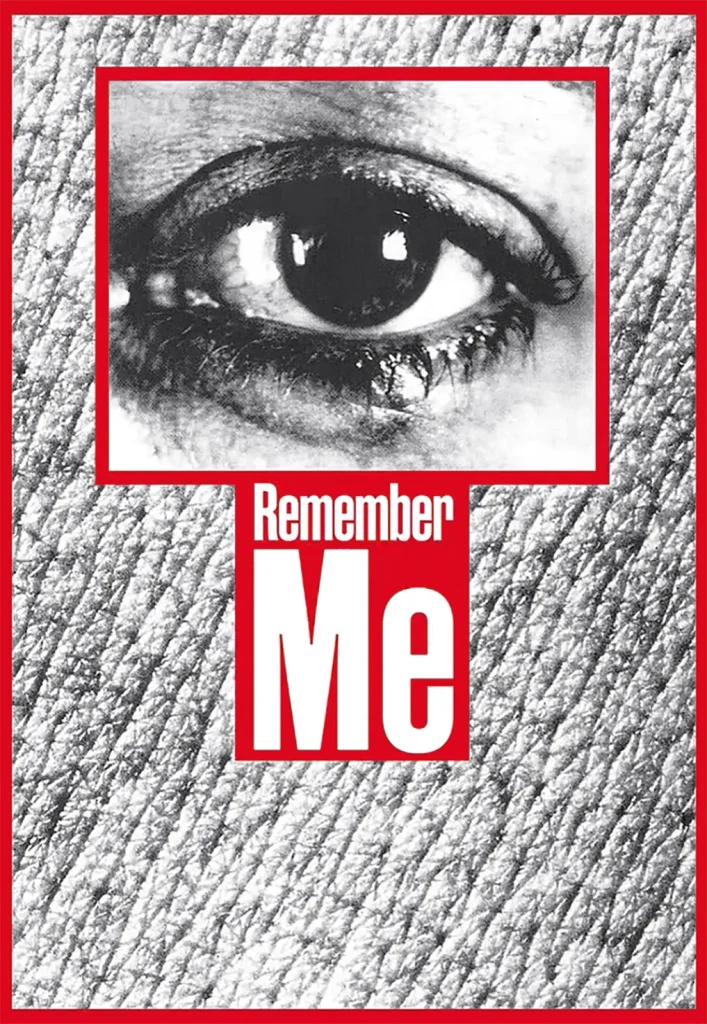
This approach builds on a visual language Kruger has developed since the late 1970s. Drawing on her early experience in graphic design, advertising and fashion publishing, the artist began combining appropriated photographic imagery with confrontational statements that borrowed the immediacy of commercial communication while challenging its ideological foundations.
Her work has consistently questioned how images construct desire, reinforce gender roles and influence the ways individuals perceive themselves and others. By adopting the mechanisms of persuasion associated with consumer culture, Kruger exposes their capacity to shape social behaviour and political consciousness.
In The History of Tears, these concerns extend beyond the static image. Two video works introduce a succession of faces, gazes and words that confront viewers with the overlapping forces of pleasure, fear, violence and control.
Among them is Power, Pleasure, Desire, Disgust, first presented in 1996 at the Wexner Center for the Arts in Columbus, Ohio. Its inclusion establishes a dialogue between different moments in Kruger’s practice, revealing the continuity of questions that have remained central to her work for decades.
The exhibition’s title introduces another dimension to this investigation. Tears become more than an expression of individual emotion. They suggest a history of relationships shaped by inequality, intimacy, conflict and the unequal distribution of power.
For Kruger, the body is never entirely separate from the political structures surrounding it. Personal experiences of desire, shame, vulnerability and loss are inseparable from broader systems of domination, whether operating through institutions, public discourse or intimate relationships.
This tension between the individual and the collective gives the installation its particular intensity. Words circulate through the museum with the visual force of commands, yet their meanings remain unstable. They can function as accusations, declarations, warnings or fragments of an internal monologue.

The relationship between Kruger’s work and the Bourse de Commerce is especially significant. Ando’s architecture, defined by its monumental concrete cylinder and carefully controlled geometry, provides a striking counterpoint to the visual and verbal saturation of the installation. What might otherwise appear as an exercise in architectural restraint becomes a space of confrontation.
Rather than simply occupying the museum, Kruger uses its physical structure to amplify the mechanisms through which language acquires authority. The visitor is no longer positioned at a comfortable distance from the work but becomes part of an environment in which messages compete for attention and interpretation.
The exhibition also unfolds alongside Remember Me, the Pinault Collection’s extensive presentation dedicated to the history of photography. Its title references Kruger’s Untitled (Remember me) (1988/2020), establishing a further connection between her investigation of images and the wider visual culture explored throughout the museum.
Nearly five decades after developing the foundations of her distinctive visual language, Kruger continues to question the systems through which meaning is produced and circulated. In an environment increasingly defined by digital communication, accelerated image consumption and competing narratives, her work remains particularly relevant.
The History of Tears ultimately proposes language as both an instrument of control and a potential means of resistance. Across monumental texts, illuminated surfaces and moving images, Kruger exposes the contradictions of a society in which words can simultaneously inform, seduce, manipulate and wound.
At the Bourse de Commerce, those contradictions are no longer contained within the frame of an image. They occupy the architecture itself, transforming the museum into a space where the relationship between language and power becomes impossible to ignore.

Barbara Kruger: The History of Tears
Bourse de Commerce – Pinault Collection, Paris
7 October 2026 – 25 January 2027
Curated by Matthieu Humery, with the collaboration of Lola Regard.
Credit: Bourse de Commerce – Pinault Collection, Paris
BARBARA KRUGER
is an American conceptual artist known for her distinctive combination of images and bold, direct language. Drawing on the visual codes of advertising, graphic design and mass media, her practice investigates how power, gender, desire and identity are constructed through the messages that surround us. Since the late 1970s, Kruger has transformed photographs, words, architecture and moving images into confrontational environments that challenge the viewer’s position. Her instantly recognisable visual language has made her one of the most influential figures in contemporary art, while her exploration of persuasion, representation and control remains particularly resonant within today’s image-saturated culture.