
‘LA GRAZIA’ EXPLORES THE DIALOGUE BETWEEN RADICAL DESIGN AND PALAZZO MONTI
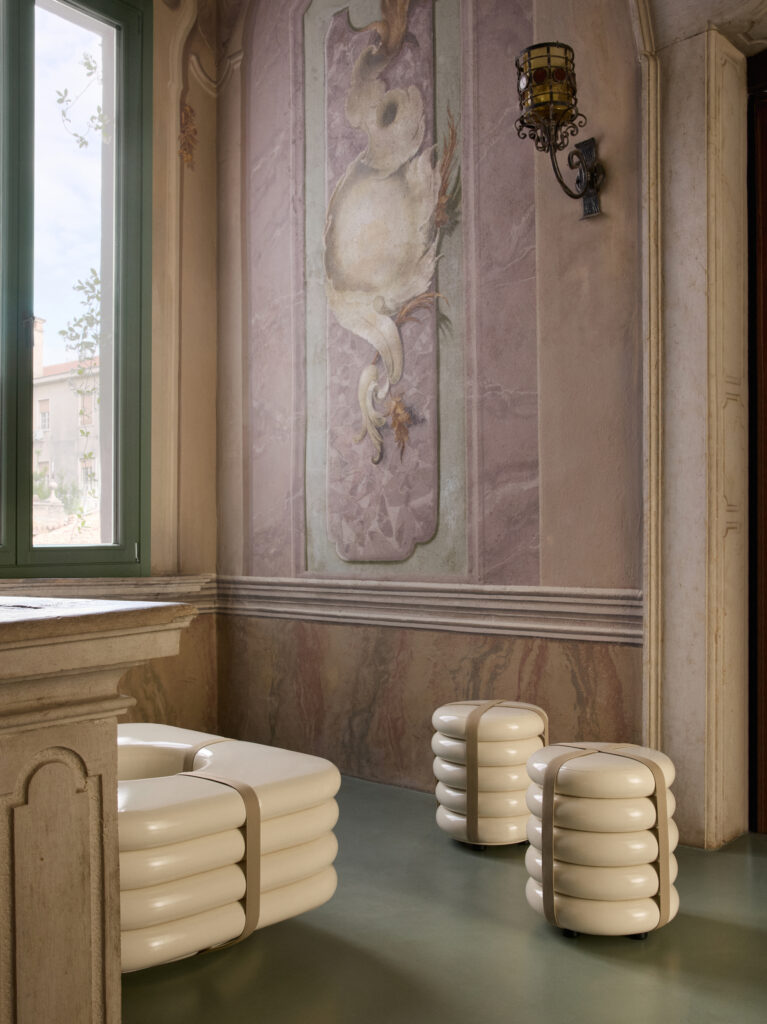
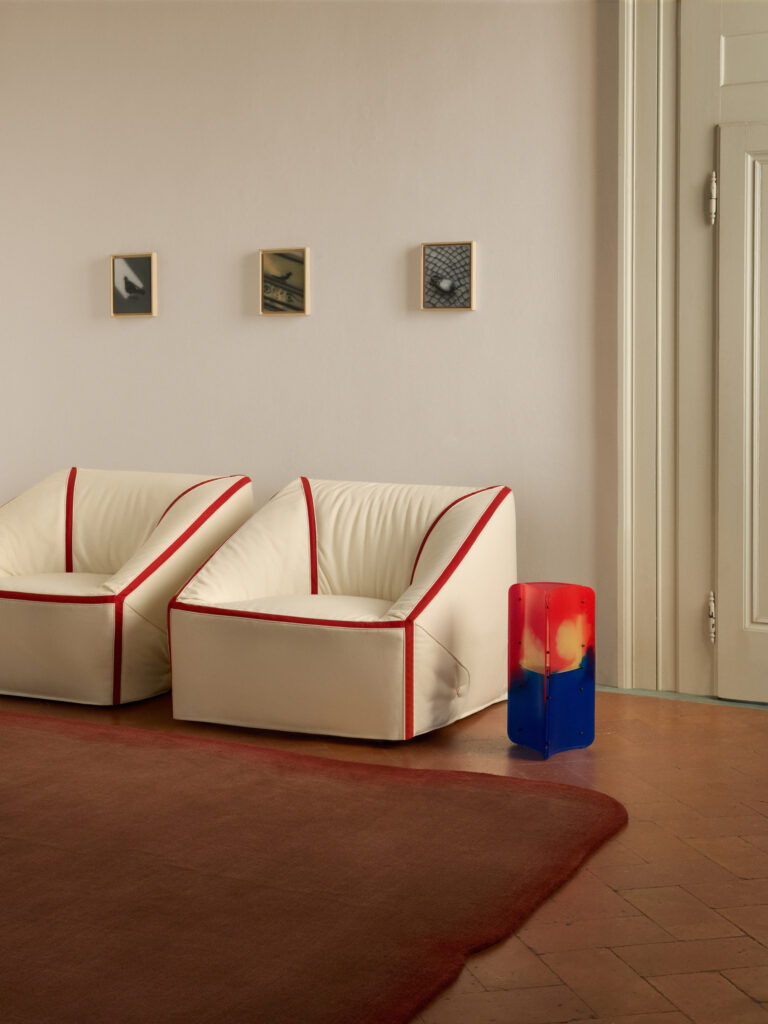
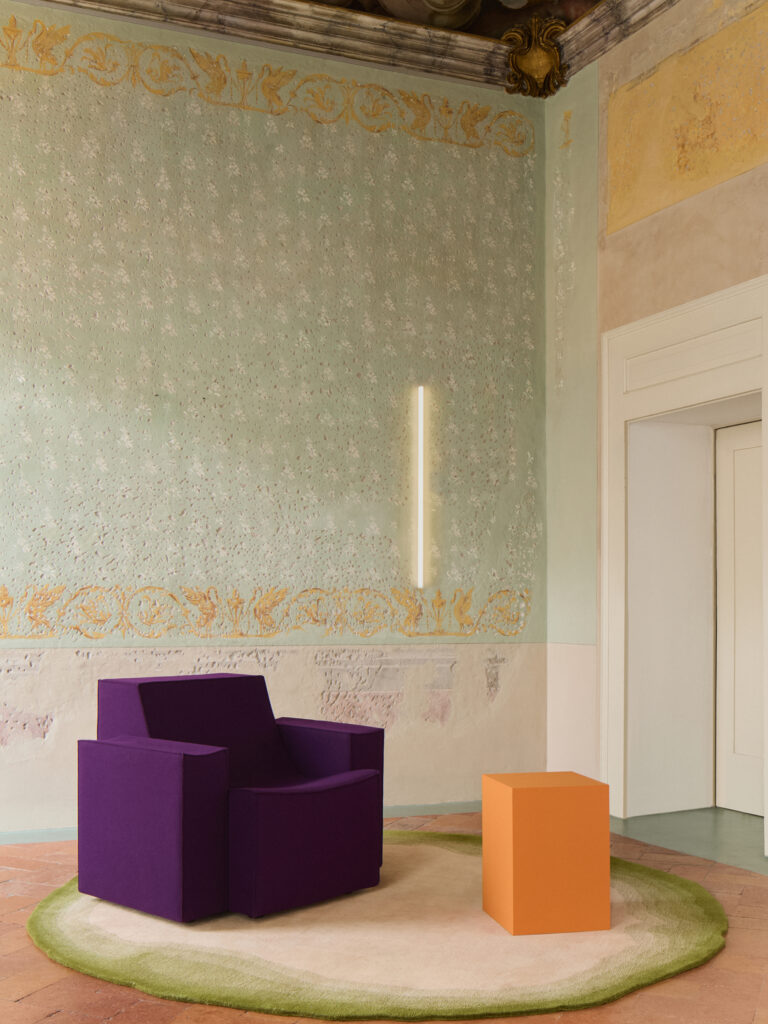
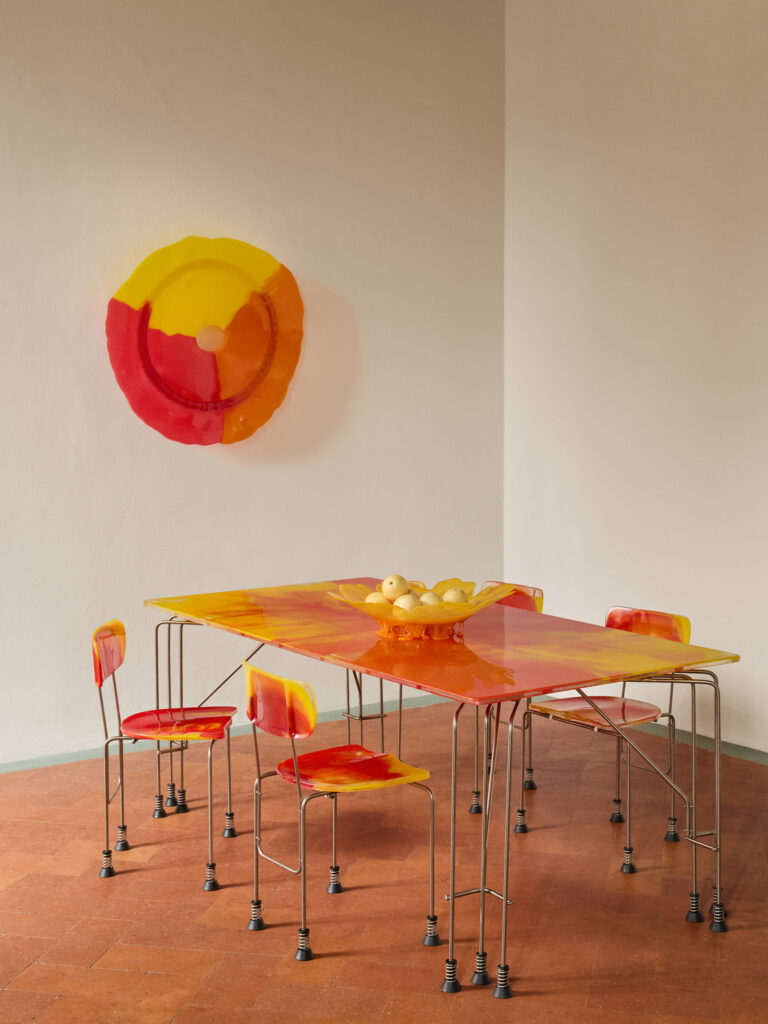
Set within the historic interiors of Palazzo Monti, La Grazia explores the dialogue between Meritalia’s radical design heritage, contemporary photography and domestic space.
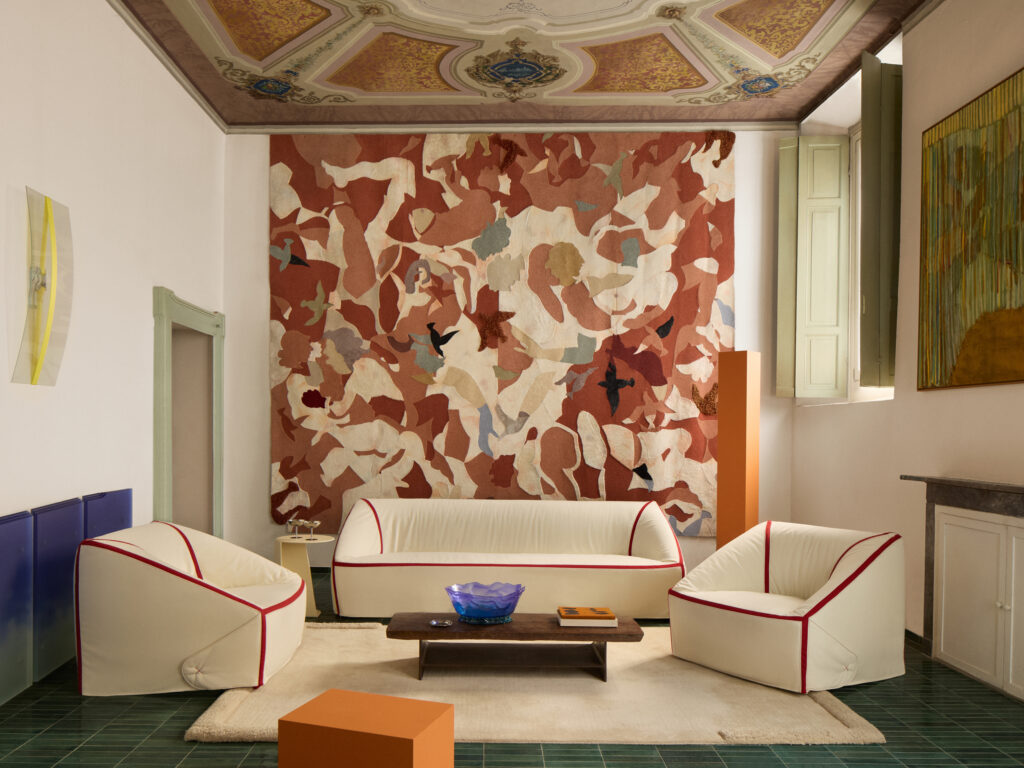
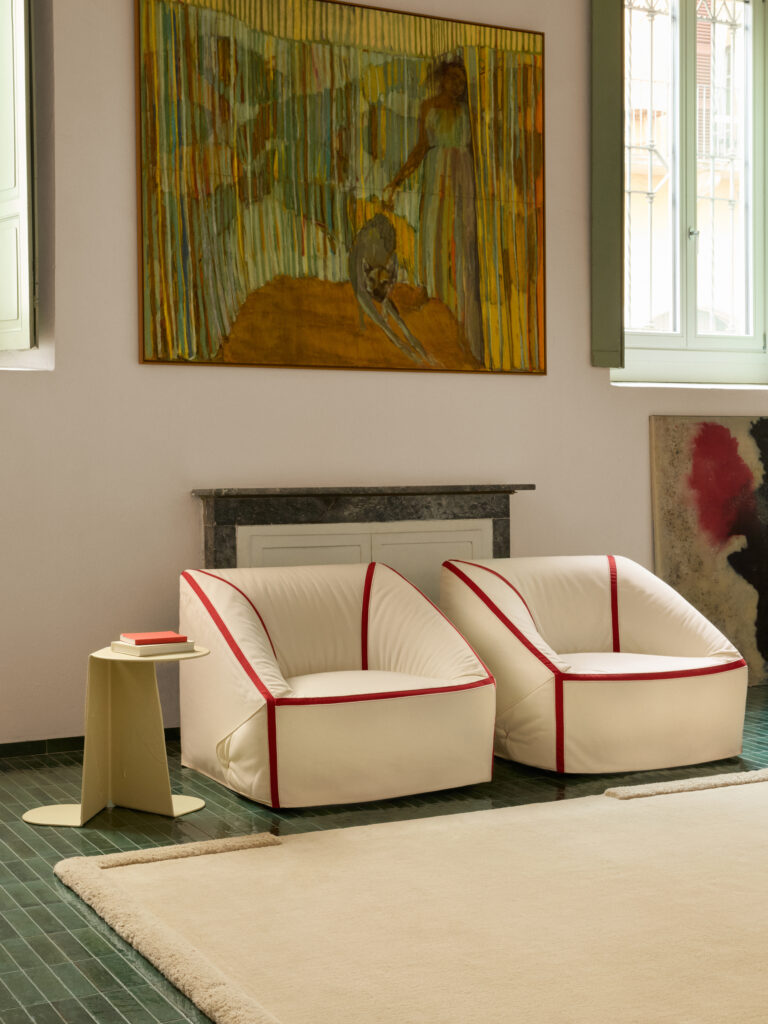
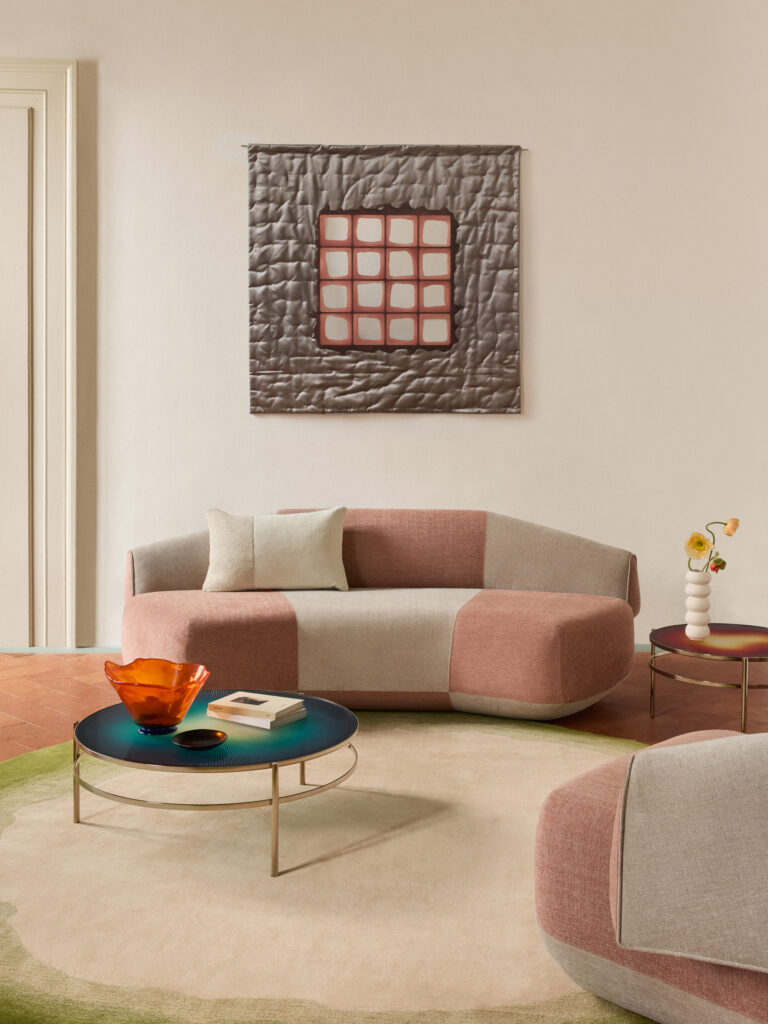
La Grazia, a new photographic project by Claudia Zalla, set within the historic interiors of Palazzo Monti in Brescia, with styling by Greta Cevenini.
Since its founding in 1987, Meritalia® has championed a design vision rooted in creative freedom and experimentation, transforming everyday objects into pieces with a bold, radical identity. Through collaborations with designers including Gaetano Pesce, Achille and Pier Giacomo Castiglioni, Mario Bellini, Carlo Contin and Giulio Iacchetti, and more recently Faye Toogood, Cristián Mohaded, Philippe Malouin and Objects of Common Interest, the brand has built a collection of furniture that envisions the home as a space for personal expression, where every design introduces a unique and memorable presence. La Grazia continues this narrative, using photography as a medium to explore and communicate Meritalia®’s design identity.
The choice of Palazzo Monti reflects this vision. A historic palace in the heart of Brescia, now home to an international artist residency, Palazzo Monti brings together architectural heritage and contemporary creative research. Its eighteenth-century frescoes, richly textured surfaces and sequence of atmospheric interiors provide the setting in which Meritalia®’s radical design language finds a new expression. Rather than being presented as isolated objects, the furnishings are integrated into harmonious living environments, creating a visual narrative in which product, architecture and everyday life coexist naturally.
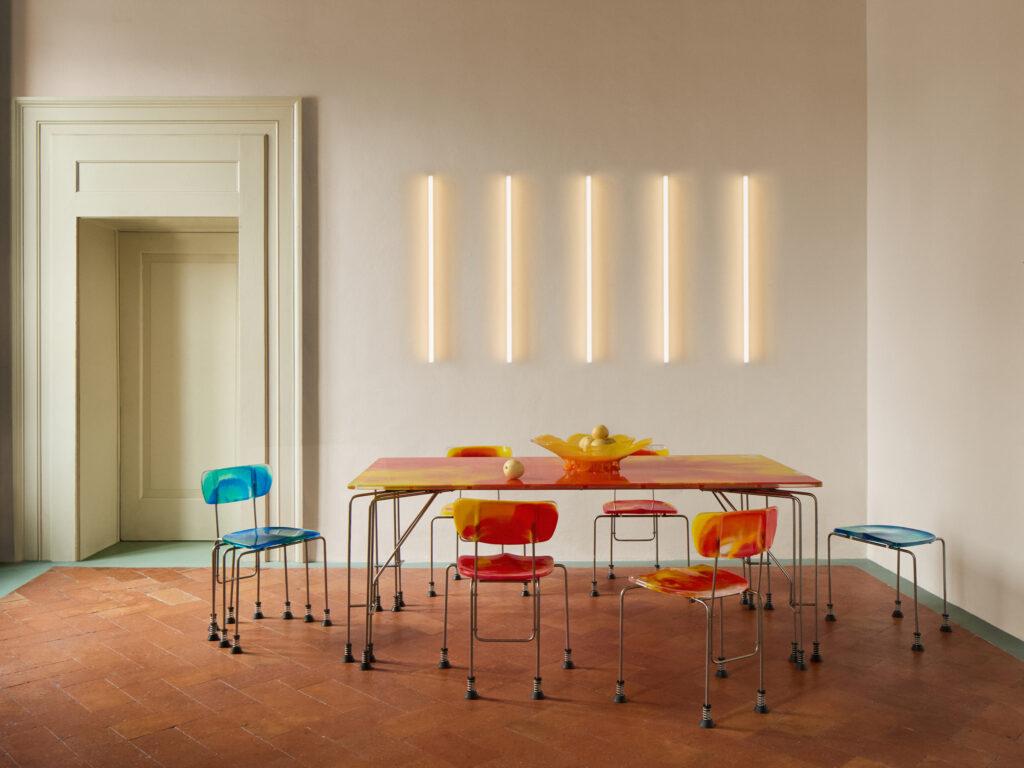
At the heart of the project are the new collections unveiled by Meritalia® at Salone del Mobile 2026 alongside some of Meritalia®’s most iconic collections, highlighting the continuity between the brand’s design heritage and its ongoing evolution. Featured pieces include Crease, the family of upholstered seating and occasional tables by Faye Toogood; Bundle, the side table and stool designed by Objects of Common Interest; Scoop, Philippe Malouin’s modular seating system; the Hug sofa and armchair and the Eyes side tables by Cristián Mohaded; the Fix bench, Morbio table and Lierna chairs by Achille and Pier Giacomo Castiglioni; the Horizon and Room rugs developed in collaboration with cc-tapis; the special re-edition of the Broadway 543 dining system, comprising table, chairs and stools; La Michetta modular seating system; and Carlo Contin’s Snake coffee tables.
With La Grazia, Meritalia® continues its exploration of image-making as a design language, staging a dialogue between the radical character of its collections and the timeless atmosphere of Palazzo Monti. The palace’s frescoes, historic surfaces and architectural richness provide the ideal counterpoint to the expressive strength of the furnishings, creating a conversation that moves beyond the contrast between past and present.
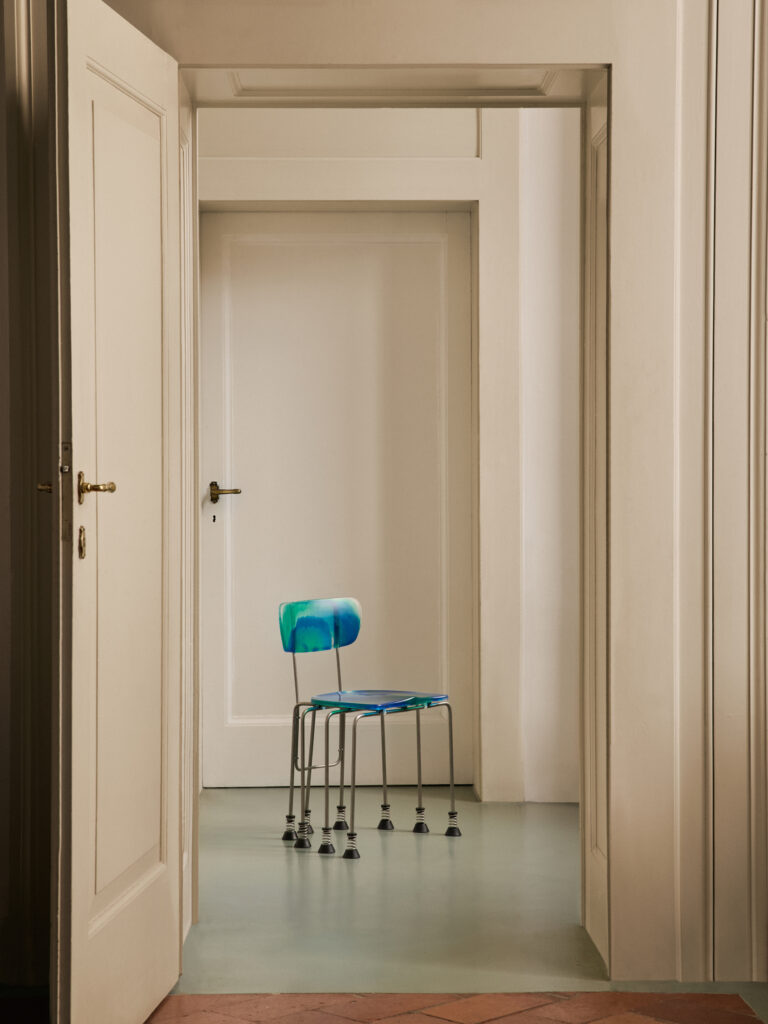
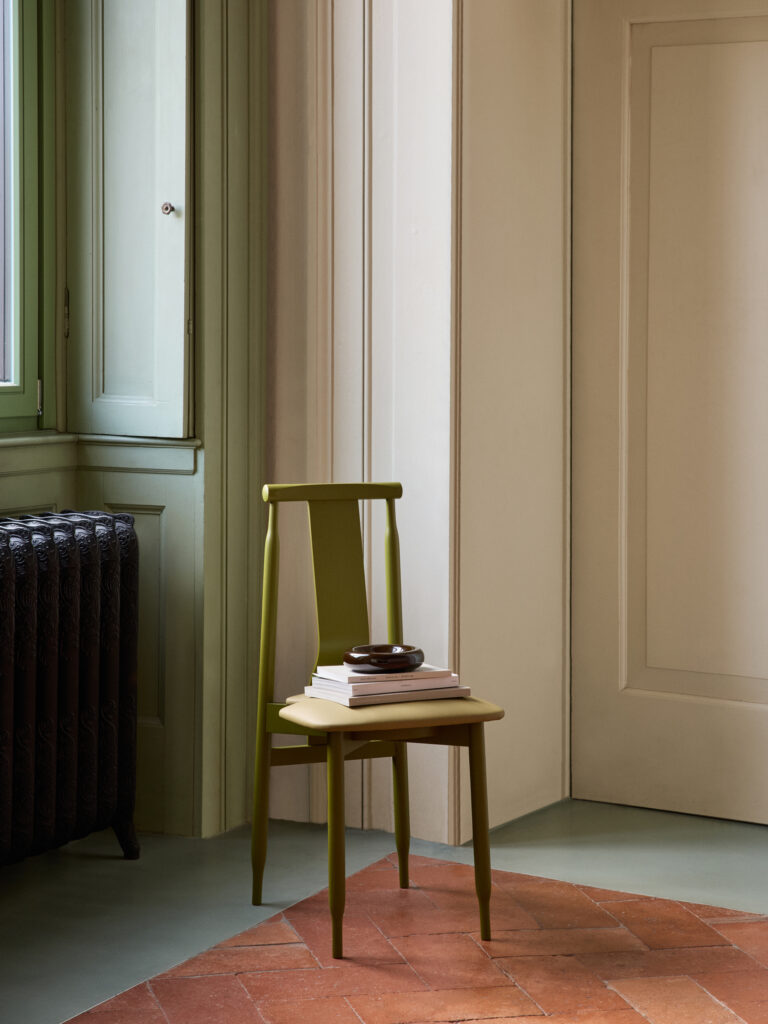
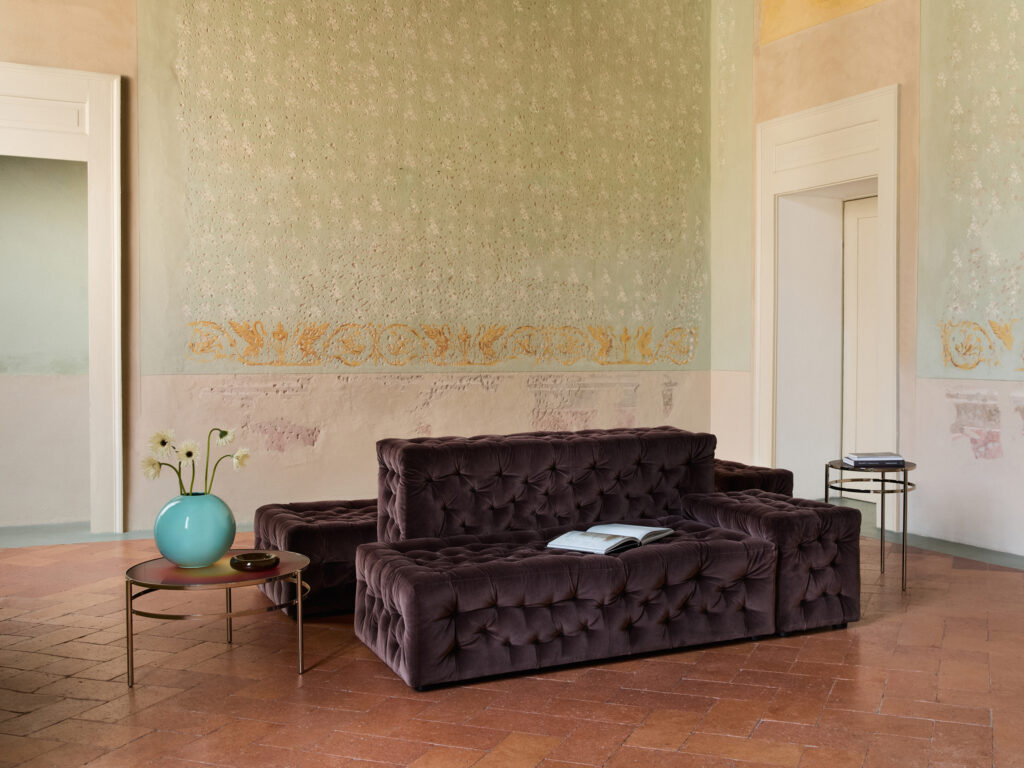
Credits: GC Agency, Meritalia®
Photo by Claudia Zalla
MERITALIA®
Since its founding in 1987, Meritalia® has been defined by a spirit of creative freedom and a deliberately unconventional energy that gives rise to objects of everyday desire. The brand serves as an incubator for a multifaceted creative vision, one that responds to the evolving aspirations of a society in constant dialogue with itself. By consciously challenging convention, Meritalia® transforms ordinary objects into extraordinary pieces, shaping a collection with a distinctly radical identity. This vision found its fullest expression in the creative genius of Gaetano Pesce, while the brand has also collaborated with designers including Mario Bellini, Achille and Pier Giacomo Castiglioni, Carlo Contin, Giulio Iacchetti and, more recently, Misha Kahn, Philippe Malouin and Francesco Meda. Since 2023, Meritalia® has been part of the Italian Radical Design group, alongside Gufram and Memphis.
Pacifico Silano Transforms Trullo Ulìa into a Landscape of Memory and Desire
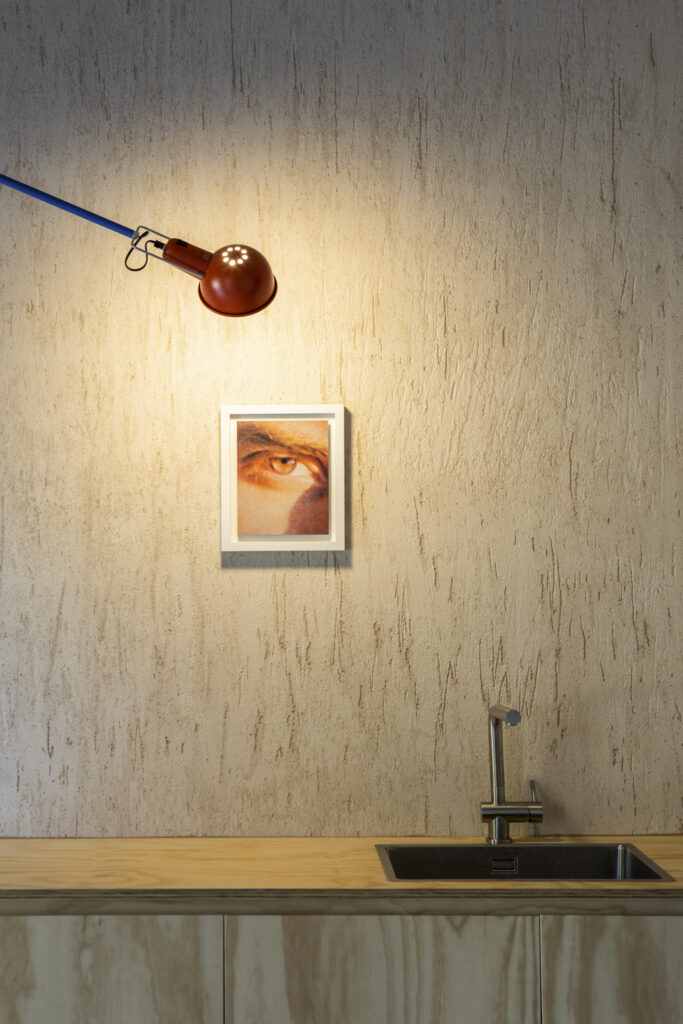
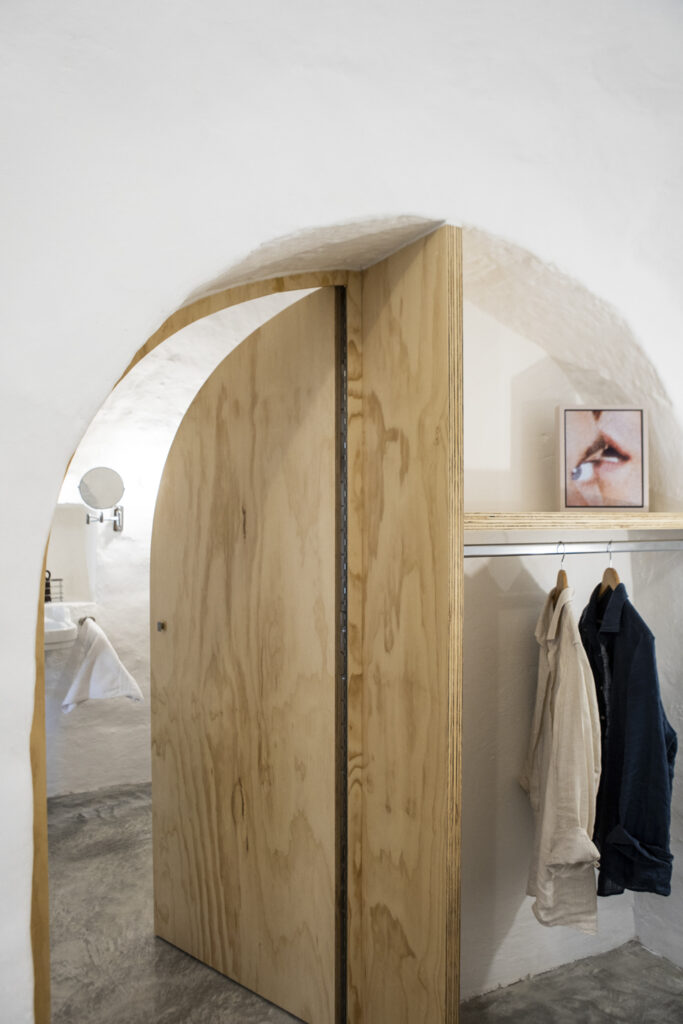
Developed during an artist residency at Trullo Ulìa in collaboration with Monti8, Sun-kissed, Red Soil, Salt Skin explores the relationship between queer archives, landscape and contemporary forms of inhabiting Southern Italy.
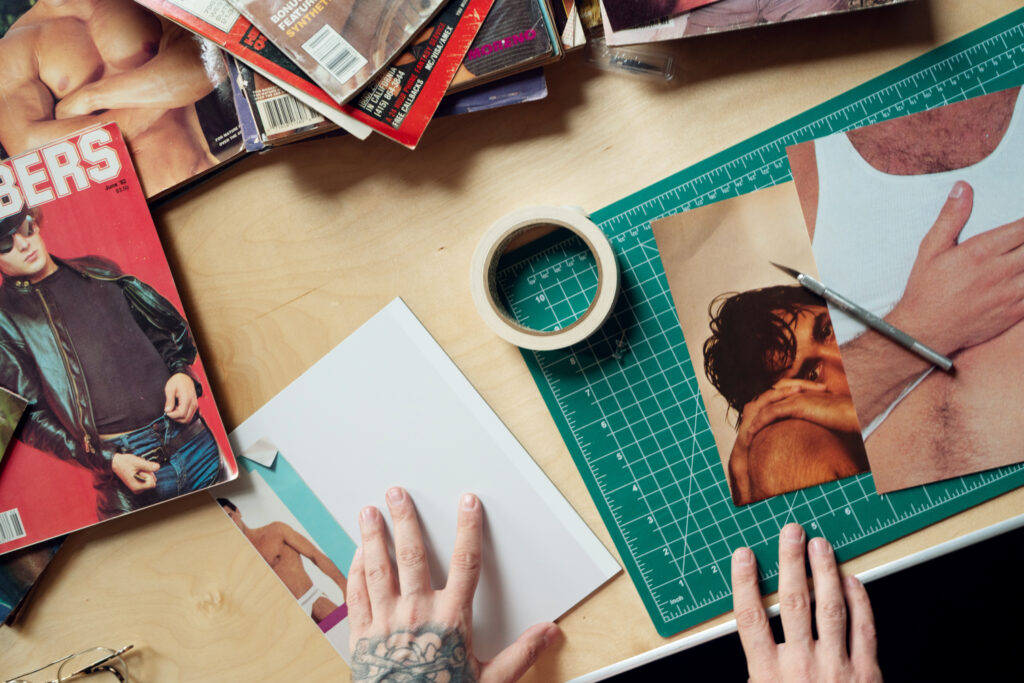
Sun-kissed, Red Soil, Salt Skin is a physical condition through which to read a territory, the bodies that move through it, and the images that emerge from it. The project takes shape within Trullo Ulìa, in the countryside surrounding Ostuni, where the landscape does not function as a backdrop but rather as a site that transforms behaviour, alters the perception of time and reshapes the quality of relationships. Sun, earth and salt become narrative and sensory elements, tools through which Pacifico Silano constructs a reflection on desire, memory and the contemporary possibility of inhabiting the South.
The red earth of Puglia’s Valle d’Itria, the blinding light, the limewashed white of its rural architecture, the dust settling on bare feet after the sea; everything within this project belongs first to a tactile rather than a visual dimension. The image does not arise from the distant contemplation of the landscape, but from physical immersion within it. It is a South that enters the body before it reaches the gaze.
Within this framework, Trullo Ulìa assumes a central role, not simply as the place hosting the residency, but as a cultural device and a critical space. Ulìa’s project deliberately distances itself both from vernacular nostalgia and from the touristic aestheticisation of the Apulian countryside. Its approach to dwelling begins with the observation of the spontaneous architecture of the Valle d’Itria: trulli, lamie and rural extensions built primarily during the second half of the twentieth century, when farmers, driven by practical needs and aspirations towards modernity, began adding new volumes to older structures without any form of academic mediation.
These apparently modest interventions, however, reveal a decisive moment in Southern Italy’s rural culture: the desire to emancipate everyday life from the exclusive sphere of agricultural labour through the introduction of small gestures of domestic representation, arches, decorative roof tiles, coloured plasterwork and ornamental details that gradually distinguished the house from the simple storage building or the architecture of labour itself.
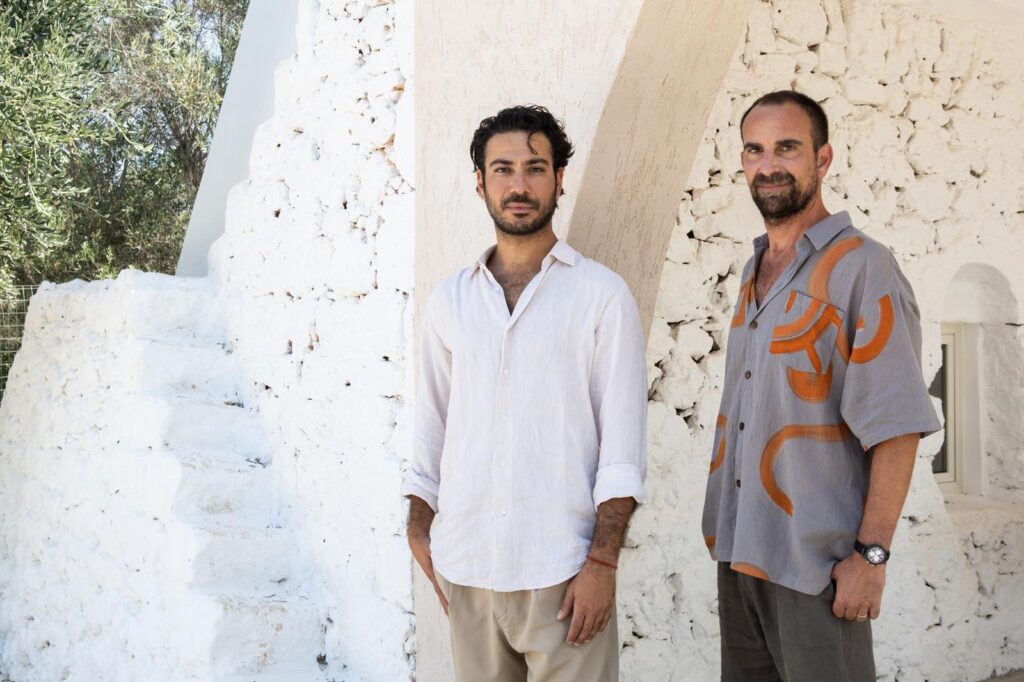
This tension between necessity and desire, pragmatism and aesthetic aspiration, is deeply embedded in Silano’s practice. Long engaged with photographic archives, queer memory and the emotional reconstruction of images, his work finds in Trullo Ulìa an ideal terrain for dialogue. Rather than documenting a place, the artist uncovers its cultural and symbolic stratifications, investigating the relationship between interior and exterior, intimacy and landscape, body and architecture.
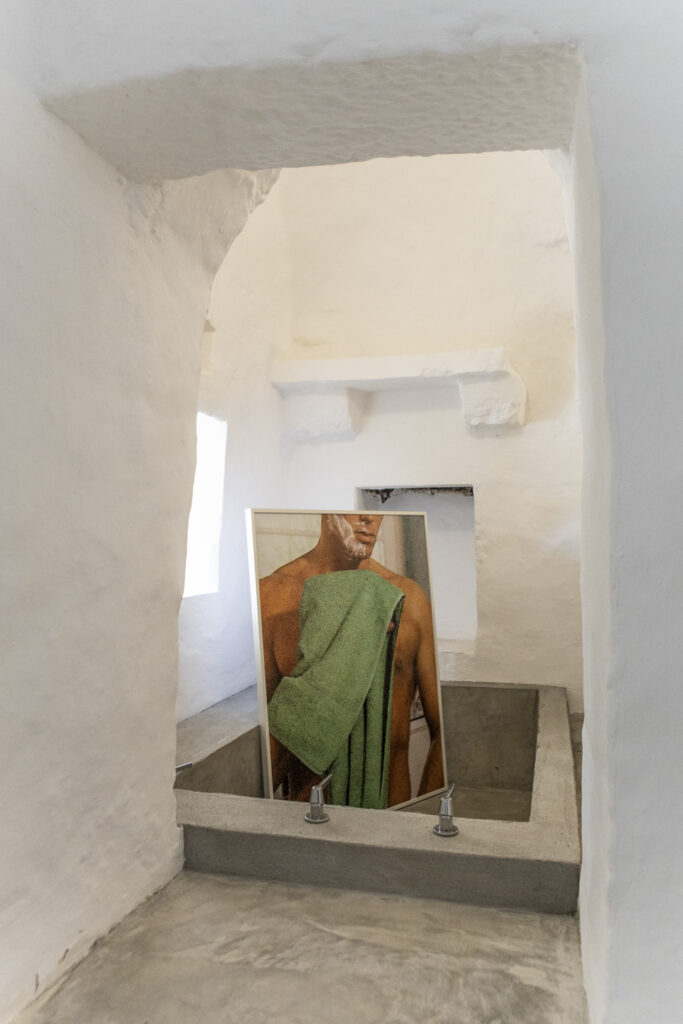
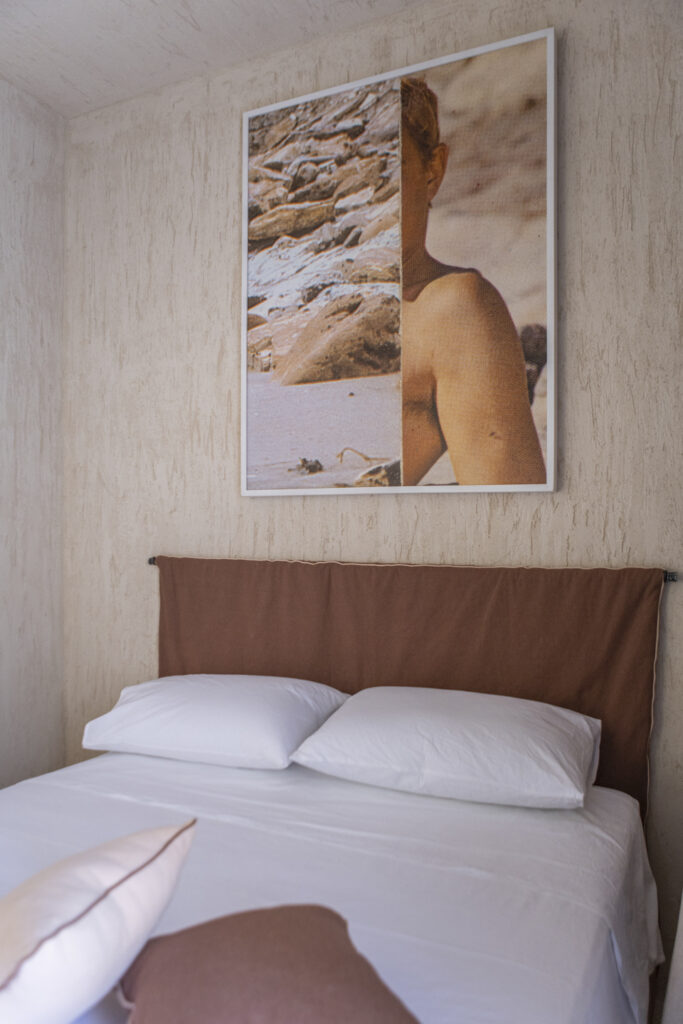
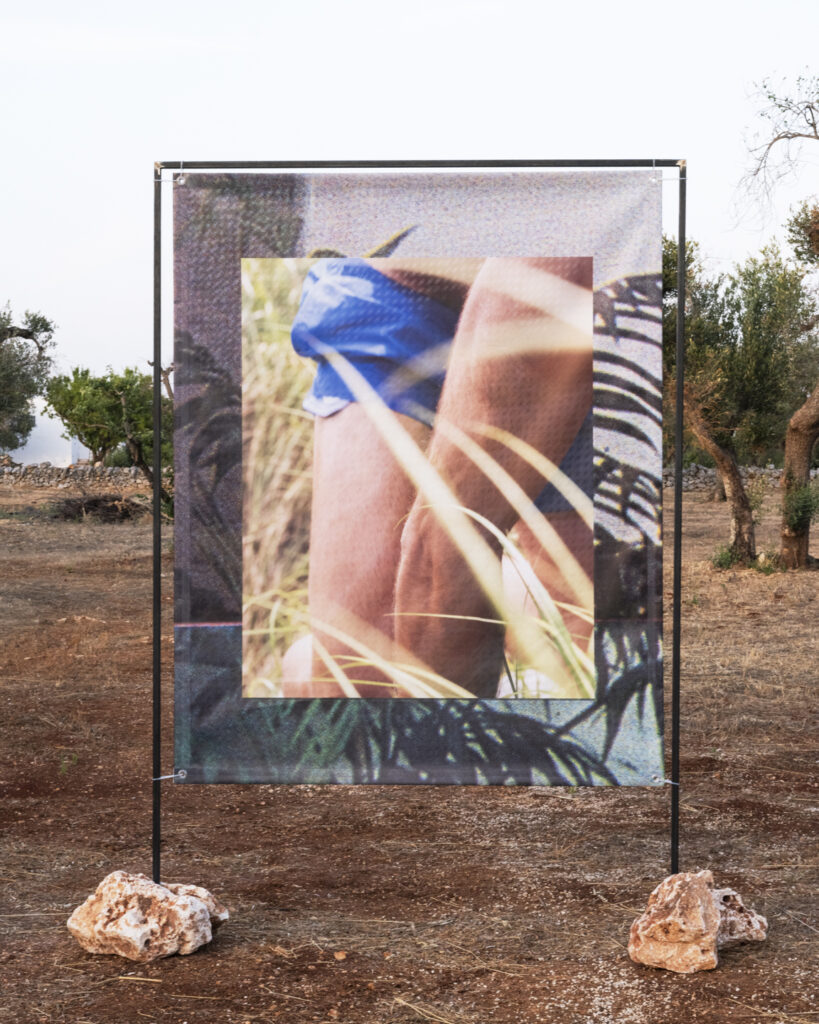
A fundamental aspect of Pacifico Silano’s practice, and one that lies at the heart of Sun-kissed, Red Soil, Salt Skin, concerns the way he constructs images through the photographic archive. The photographs he appropriates, often sourced from magazines, erotic publications and printed material from the 1970s and 1980s, are never treated as static documents or nostalgic relics. Instead, Silano intervenes through processes of montage, layering, cropping and juxtaposition, radically altering the original meaning of his source material.
The titles of his works frequently play an equally decisive narrative role. Rather than simply describing what is visible, they open alternative interpretative trajectories, redirecting the image towards unexpected emotional, political or autobiographical territories.
Stratification remains one of the defining characteristics of his artistic language. Multiple images inhabit the same photographic work without ever fully merging; the frictions, interruptions and temporal seams between one fragment and another remain deliberately visible. Likewise, his diptychs and visual pairings continuously produce shifts in meaning: one image rebalances another, destabilises it or completes it, generating readings that were never present within the original material. Through this process, the archive ceases to function as a closed memory of the past and becomes reactivated within the present. Images produced fifty years ago are not simply recovered; they are translated into a contemporary sensibility charged with emotional and affective resonance.
It is impossible not to recognise how closely this methodology mirrors the architectural work undertaken at Trullo Ulìa itself. Here too, one encounters a process of temporal stratification and coherent rewriting. The restoration of the property does not erase its rural origins, nor does it attempt to transform it into a neutral or abstractly contemporary object. On the contrary, Ulìa deliberately preserves the visible traces of the different historical moments that have shaped the site: the original sixteenth-century Saracen trullo; the spontaneous additions made during the second half of the twentieth century; the vernacular details introduced by local farmers in their efforts to modernise domestic space; and, finally, the most recent interventions connected to a renewed understanding of cultural hospitality and artistic residency.
The vocabulary changes, yet the narrative remains remarkably coherent. Just as in Silano’s work, the past is neither museumised nor romantically preserved. Instead, it is revisited, reassembled and translated into a language capable of belonging fully to the present without relinquishing its own memory. Temporal overlaps therefore become an integral component of the site’s identity. Contemporary interventions do not erase its agricultural past, just as artistic intervention never conceals the provenance of the image. In both cases, what matters is sustaining the productive tension between different temporalities, allowing time itself to remain visible as a layered surface.
It is precisely here that the decision to invite Pacifico Silano to work at Trullo Ulìa reveals itself to be not only coherent, but deeply significant. The dialogue between artist and place is grounded in a shared methodology: both operate through practices of recovery and transformation; both construct the present without erasing their origins; both understand that identity is never fixed, but rather the outcome of continuous cultural, emotional and temporal stratifications.
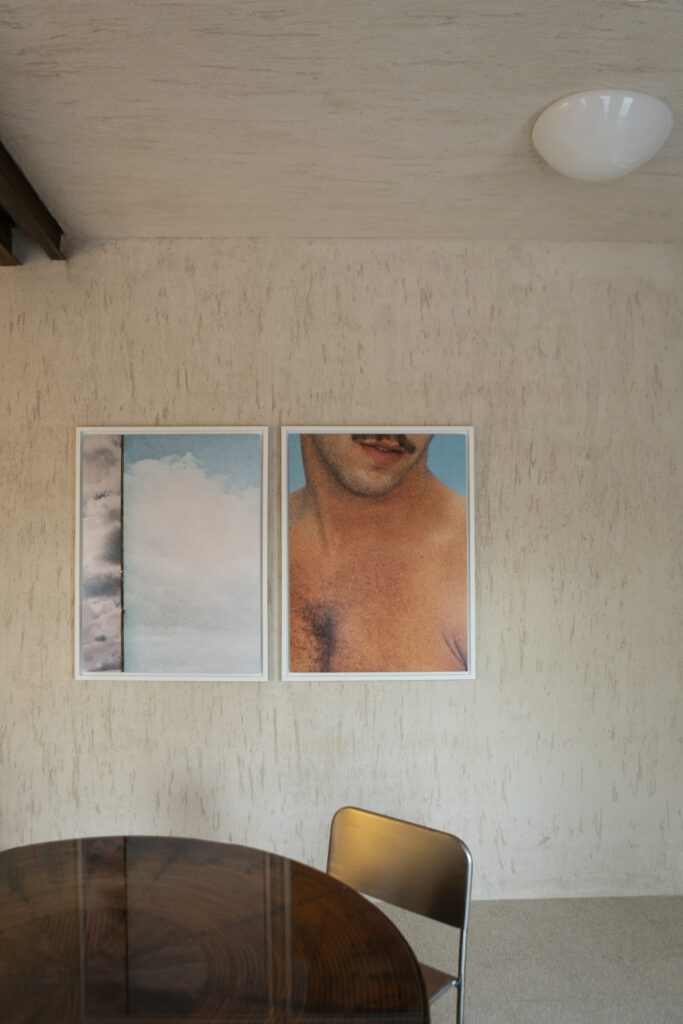
This parallel becomes even more evident through the residency process itself. A fundamental component of the project is devoted to the production of new photographs taken throughout the landscape surrounding Ulìa, along the country road leading to the sea and across the nearby beaches. Young men from the local area were photographed by Silano adopting the same poses, compositional framing and visual grammar found in the archival images that had already informed the works conceived prior to the residency.
The result is an extraordinarily subtle temporal short circuit: contemporary bodies physically enter the photographic imagination of the past, while images from decades earlier finally encounter a tangible correspondence within the very landscape that had unconsciously generated them in the artist’s imagination.
It is important to emphasise that many of the works conceived by Silano for Trullo Ulìa were developed before his arrival in Puglia. The project initially unfolded through an epistolary relationship, an exchange of stories, photographs, videos, atmospheric references and descriptions of everyday life within the territory. Before encountering the place itself, Silano had already constructed its emotional geography. The Apulian countryside first existed as a desired image, an affective projection, a landscape imagined across distance. His physical arrival at Ulìa does not interrupt this process; rather, it simultaneously completes and unsettles it, allowing the real territory to enter into dialogue with the one previously imagined.
In this sense, the residency also becomes a reflection on the ways in which places are continually constructed through images, desires and shared narratives. Silano’s Puglia belongs neither to folklore nor to tourism. Rather, it is a Puglia mediated by the archive, by queer imagination, by cinematic memory, by the iconography of the Mediterranean and by the lived experience of inhabiting a place collectively. Photographing local young men in the same poses as the models appearing in vintage photographs therefore becomes an act of superimposing different temporalities without hierarchy, collapsing the distance between archive and present, between memory and lived experience.
The male body occupies a central position within this project, not as a heroic or performative figure, but as a vulnerable presence. It is a body that sleeps, sweats, gathers dust, desires and moves through the landscape without ever fully separating itself from it. The queer dimension of the project never appears as an explicit ideological statement; instead, it emerges as a sensitive practice of inhabitation. Queer is the way intimacy is built through shared rituals. Queer is the suspension of productive time. Queer is the possibility of transforming a rural space traditionally associated with the patriarchal family into a site where other forms of relationality and belonging can emerge.
The sea likewise becomes a profoundly corporeal element within this construction. Its karst coastline, with its sharp white rocks, wind-carved coves and salt water that lingers on the skin until nightfall, introduces another understanding of Mediterranean sensuality: not the polished hedonism of luxury tourism, but a rough, tactile sensuality. Returning from the sea without showering, sitting down to dinner with salt still drying on the skin, allowing the evening air to slowly complete what the water has begun.
The entire project ultimately constructs a reflection on the Mediterranean as a space of slowness and transformation. It is not a mythical or nostalgic Mediterranean, but a contemporary one, shaped by tensions between tourism and authenticity, rurality and cosmopolitan desire. Within this context, Trullo Ulìa does not function as a refuge, but as a laboratory for new forms of inhabitation, where architecture, art and everyday life continually intersect, contaminate and reshape one another.
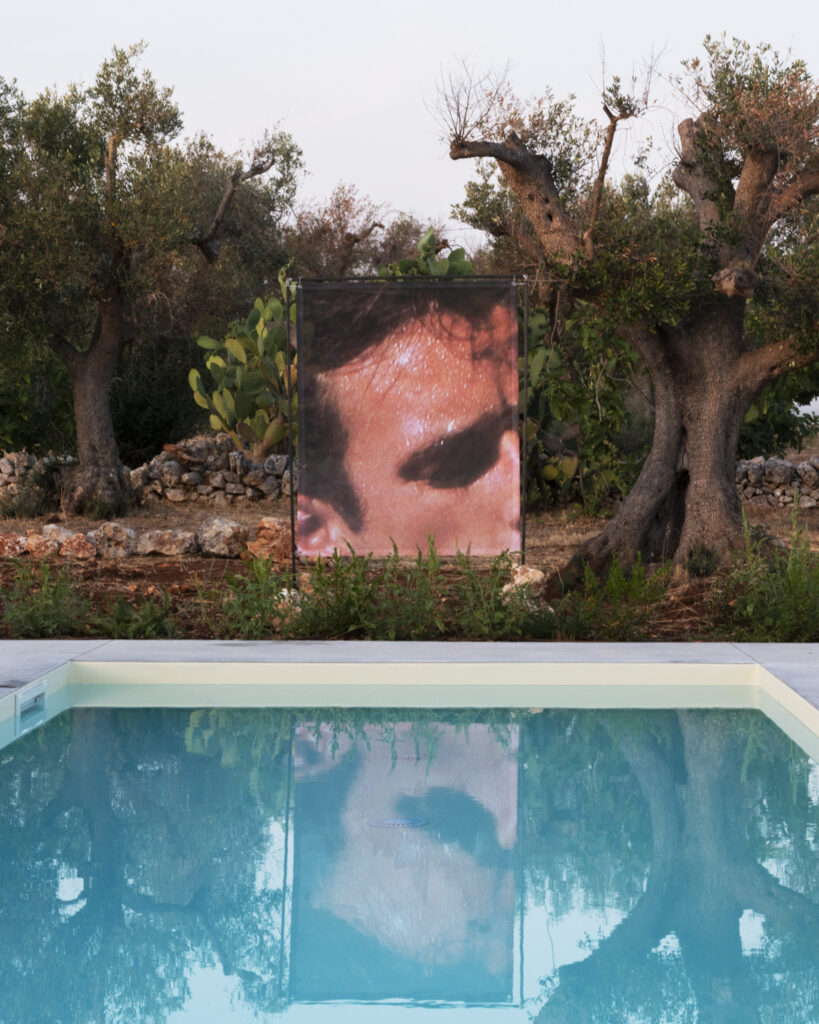
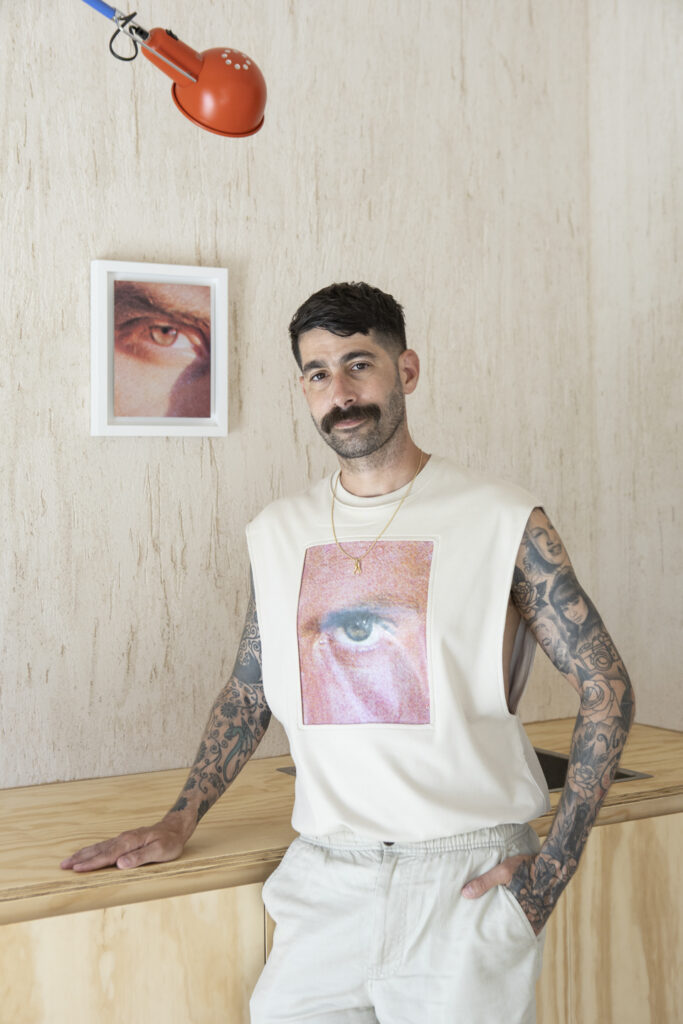
From July 19 to August 21, Trullo Ulìa is open for visits by appointment only.
MONTI8 in collaboration with Trullo Ulià.
Institutional partner: Fondazione Pino Pascali
Credit: Trullo Ulìa
PACIFICO SILANO
Born in 1986 in New York, lives and works in New York
2012 MFA in Photo, Video and Related Media: School of Visual Arts, New York, NY. 2008 BFA in Photography: Pennsylvania College of Art & Design, Lancaster.
2025 Assume The Position, Monti8, Rome, IT 2025 Artefiera 2025, Bologna, solo booth
Elegy to The Void, Curated by Eric Shiner, New York, NY 2024 Psychosexual Thriller, Island Gallery, New York, NY 2023 Sweetest Kill, Monti8, Rome, IT
2022 Men Play Games, Luis De Jesus Gallery, Los Angeles, CA
If You Gotta Hurt Somebody, Please Hurt Me, Rubber-Factory, New York, NY (2 Location Solo Show) If You Gotta Hurt Somebody, Please Hurt Me, Fragment Gallery, New York, NY (2 Location Solo Show) Don’t Worry Baby, Monti 8, Latina, Italy
2021 Cowboys Don’t Shoot Straight ( Like They Used To), Houston Center for Photography, Houston, Texas Miart, Milano, duo show
2020 I Won’t Last A Day Without You, Melanie Flood Projects, Portland, OR Time to Come, The Eye Sees, Arles, FR
The Eyelid Has Its Storms…, Light Work, Syracuse, NY 2019 Fragment Gallery at NADA MIAMI, Miami, FL
Time Is An Ocean But It Ends At The Shore, Rubber-Factory, New York, NY Fragment Gallery at Sunday Art Fair, London, UK
How To Disappear, Fragment Gallery, Moscow, RUS
Speaking Little, Perhaps Not A Word, Bronx Museum’s Block Gallery, New York, NY After Silence, Pennsylvania College of Art & Design, Lancaster, PA
2024 Fountainhead Artist Residency, Miami, FL
2021 The Paris Photo / Aperture Foundation Shortlist for First Book Prize The Rencontres d’Arles Book Award Shortlist for Artist Book of the Year
The Silver List, Silver Eye Center for Photography, The Black List, Carnegie Mellon 2020 Silver Art Projects Studio Residency
2019 Bronx Museum of the arts, AIM AT 80 White Street Artist Residency 2018 BRIC Media Arts Fellowship
Giardino Project: What Grows Between Distance and Belonging
A reflection on territory, multispecies ecologies and contemporary agriculture through the sixth chapter of giardino project and the work of Michele Guido.
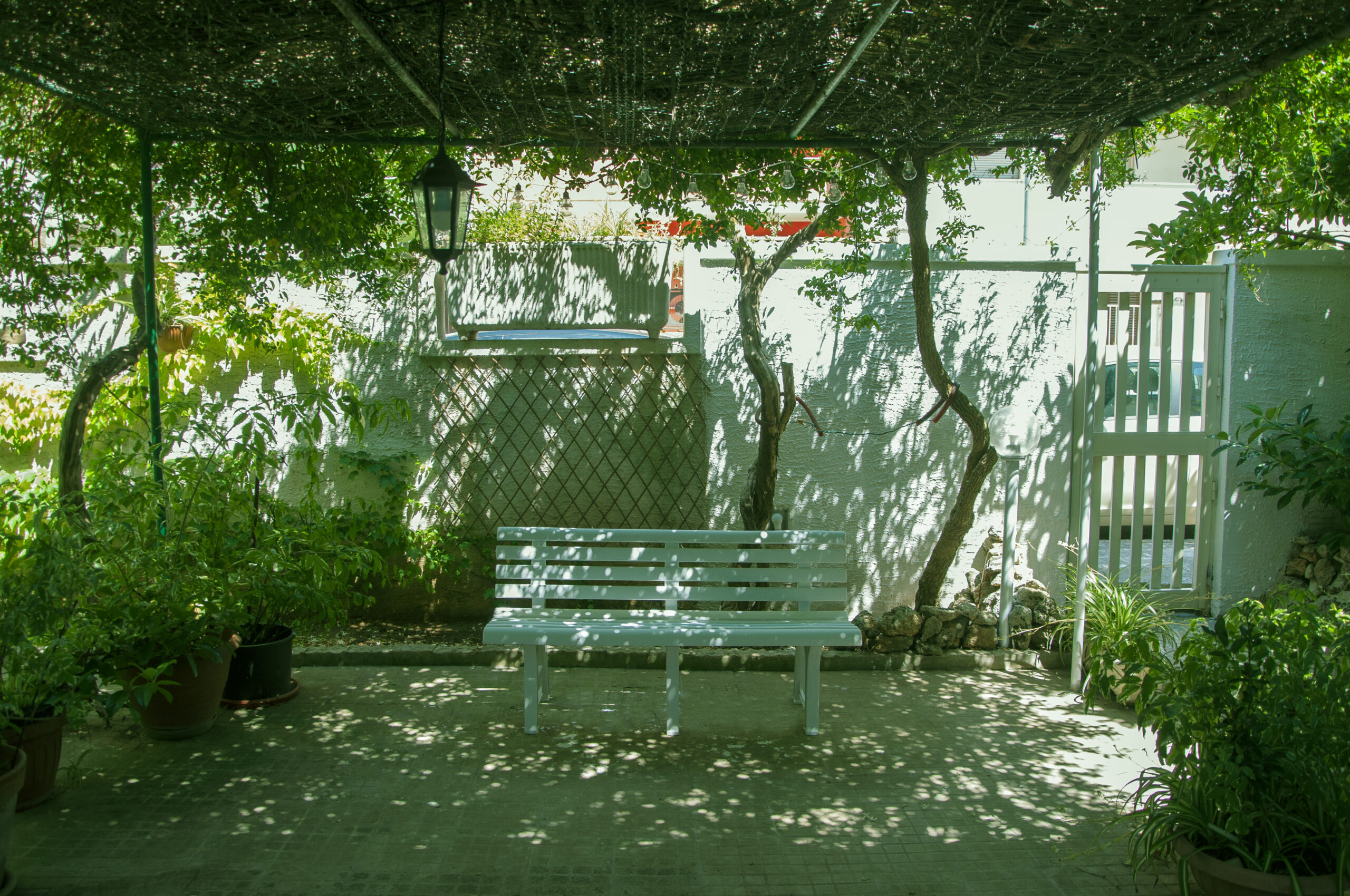
Speaking about giardino project today, seven years after Volume 0, means recounting a place that is not merely familiar or geographical. The garden, part of my apartment in Trepuzzi, just a few minutes from Lecce, has gradually transformed from a private domestic space into a collective and hospitable form of contemporaneity: a critical device that generates relationships, imaginaries and practices capable of interpreting the present and continually redefining the project’s evolving grammar.
giardino project exists primarily during the summer months, as for the rest of the year I work as a lecturer in Art History in Turin. This distance allows me to observe the reality of my territory through an exploratory lens. Living and working in Southern Italy is complex, yet operating from outside the region demands commitment, perseverance and a form of devotion to one’s homeland. It is precisely within this tension, between belonging and distance, rootedness and mobility, that the impulse sustaining the project emerges. The legitimacy of living and working within a territory lies in continuity, relationships and a cultural and political independence that does not rely solely on recurring forms of state support, but on the ability to build, over time, a generative, autonomous and free organism.
This seasonality, alternating between absence and return, thus becomes an essential component of giardino project, allowing themes, intuitions and urgencies to settle and mature while generating ever-evolving modes of research, study and interpretation. By its very nature, the garden embodies a plural idea of hospitality and sensitivity that extends beyond the domestic sphere, configuring itself as a neutral and multispecies territory where forms of life, presences and visions coexist without hierarchy. From this perspective, the garden operates as a system of political connections, artistic and ecological practices, a shared landscape of coexistence and care that offers both a method and an attitude towards dialogue with the many presences that traverse and intersect it: from botany to the legacies of colonialism, from cultural ecologies to migration and conflict, through to extractive economies and the forms of responsibility that shape the field of the visible.
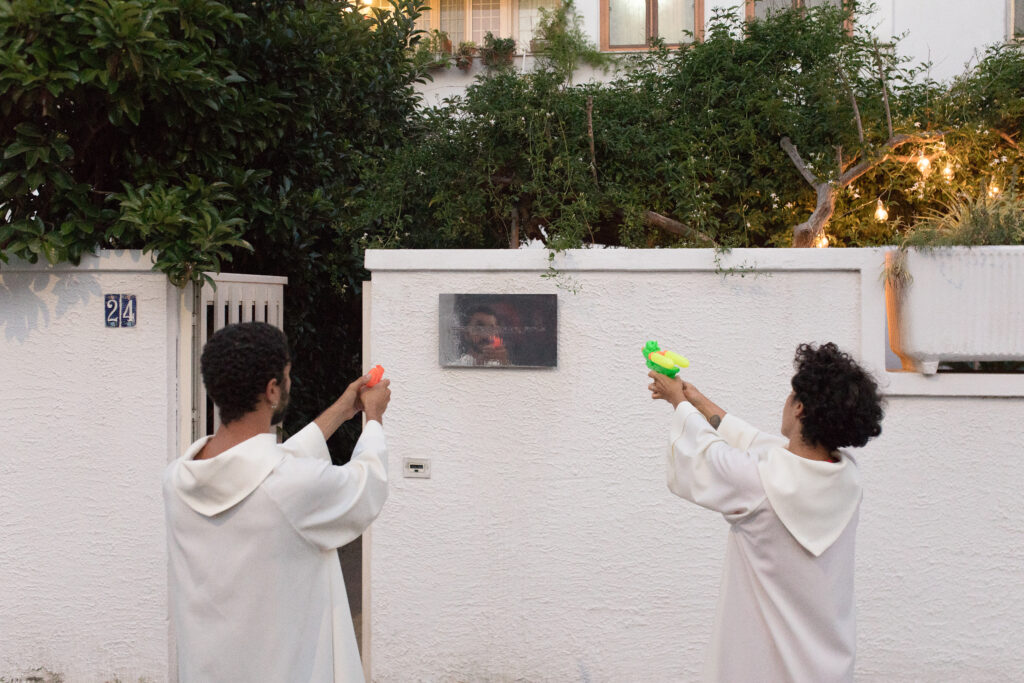
With Volume 6, entitled Seed · Plant · Flower · Fruit (scheduled for July 22 and 25), the garden, in the finest English tradition, opens itself to the countryside and, by extension, to the contemporary condition. This edition reflects on the artistic research of Michele Guido (Aradeo, Lecce, 1976), represented in Italy by Lia Rumma Gallery and Z2O Sara Zanin Gallery, whose work addresses the urgencies of the Salento agricultural landscape as a diffuse garden, structured as a complex cultural ecosystem in which human labour, spontaneous ecologies, vernacular architectures and layered memories coexist and continuously transform one another.
Michele Guido does not observe the countryside through a nostalgic or aestheticising lens; rather, he moves through it as a field of forces where botany, geology, territorial memory and extractive economies intertwine. Rooted in the study of living forms and the genealogies of species, his practice constructs visual and spatial devices that connect landscapes, historical stratifications and ecological processes, transforming the garden into a site for a political and morphological reading of the present. Volume 6 addresses the transformations of the contemporary agricultural landscape, revealing how the land is increasingly governed by algorithmic systems and industrial processes.
One of the opening scenes of Interstellar (2014) demonstrates how the American reality of automated agriculture replaces direct relationships with the soil through digital protocols. Shifting perspective and geography, we can observe how the global dynamics described by Cao Fei, particularly in relation to her recent solo exhibition in Milan, reveal how Chinese agricultural automation and algorithmic systems effectively strip the landscape of its human dimension, reducing it to productive infrastructure. Agriculture, transformed into a high-energy apparatus, contributes to the climate crisis, diminishes biodiversity and distances humanity from the landscape itself. Aware and conscious, though not yet entirely indifferent to this fracture, we find resonance in the multispecies perspective theorised by Donna Haraway, according to whom every landscape is the result of entangled relationships between humans, plants, animals, microorganisms and technologies: a continuous process of co-production that defines our world. Yet the computational grammar governing contemporary agriculture tends to simplify these relationships, reducing ecological complexity to a sequence of optimisable data.
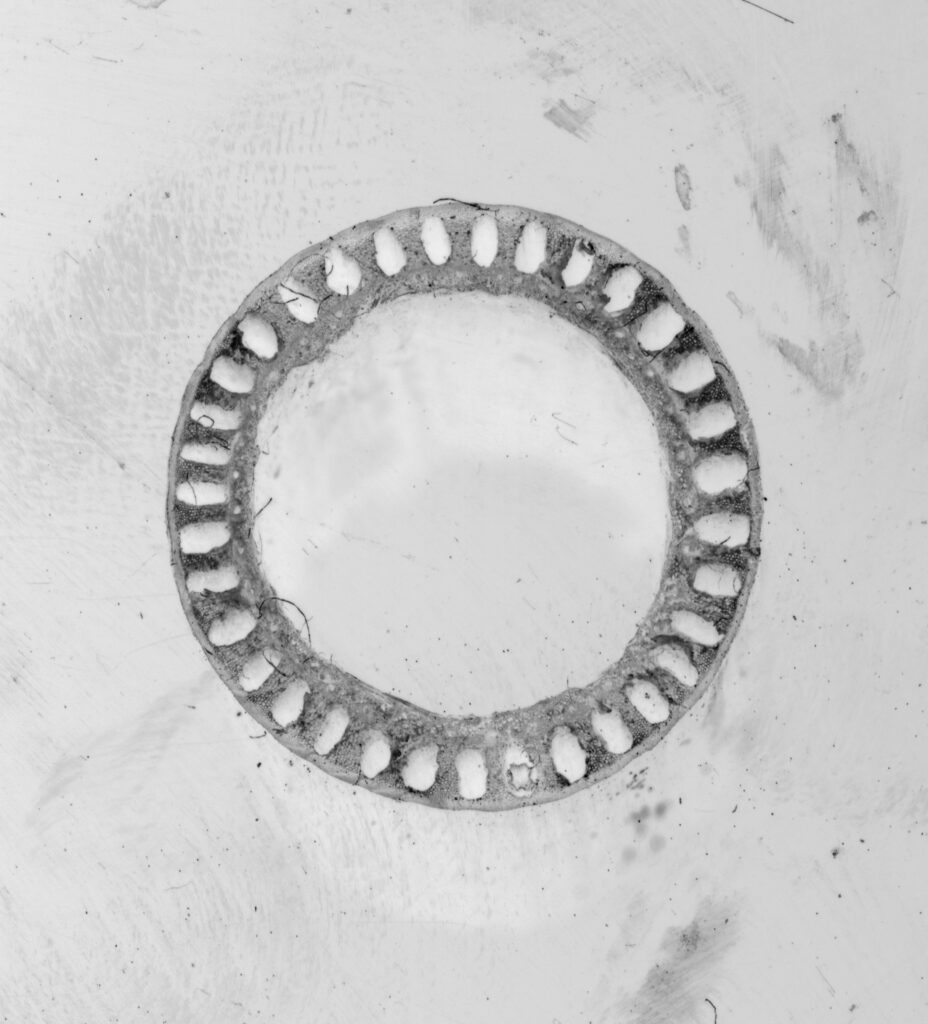
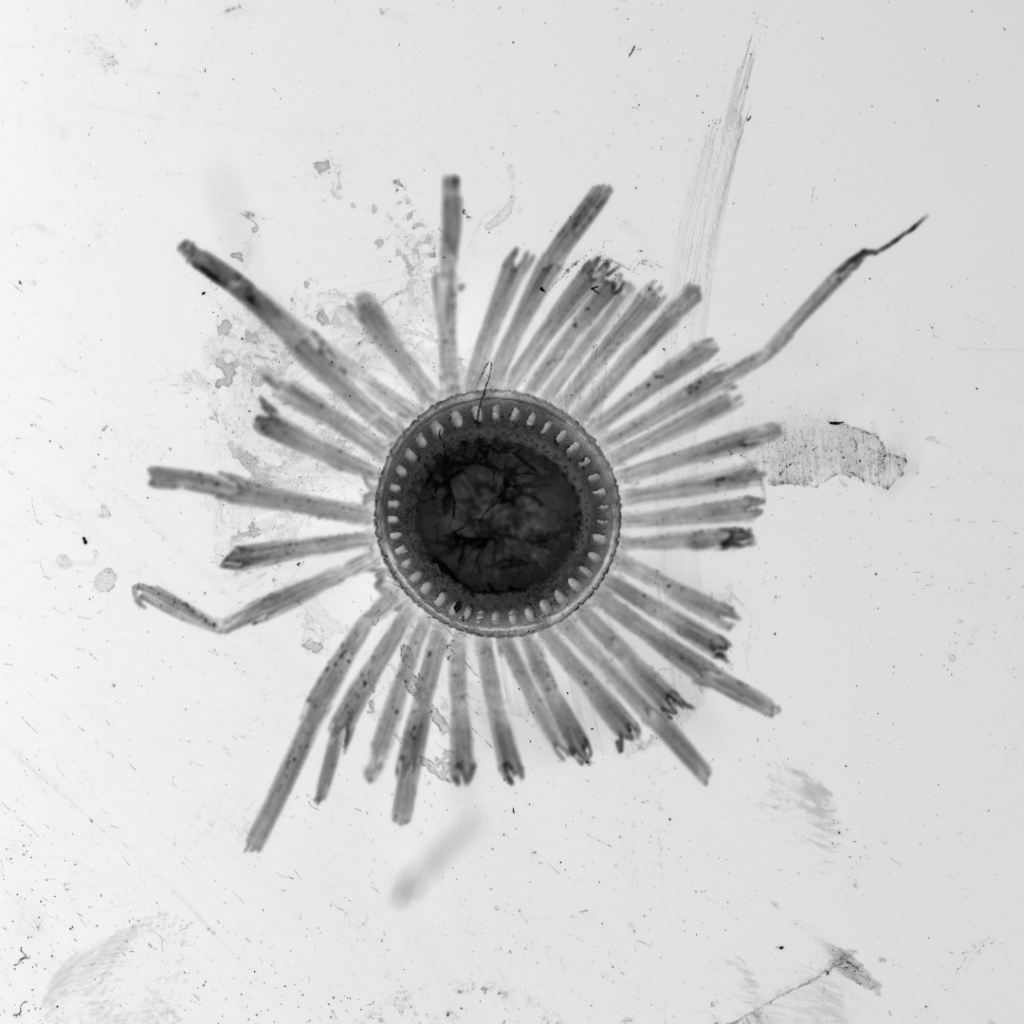
The reflections emerging through Seed · Plant · Flower · Fruit intersect with Michele Guido’s research, which for years has explored the garden and landscape as genetic and temporal structures. Drawing upon the Japanese concept of MA, which unites space and time within a single experiential interval, the artist’s work functions as a cognitive matrix capable of revealing latent relationships between body, environment and representation. The pagghiare, dovecote towers, irrigation channels, tomato fields and Mediterranean scrub become perceptual structures through which to read the relationship between agricultural gesture, labour, care and territorial regeneration.
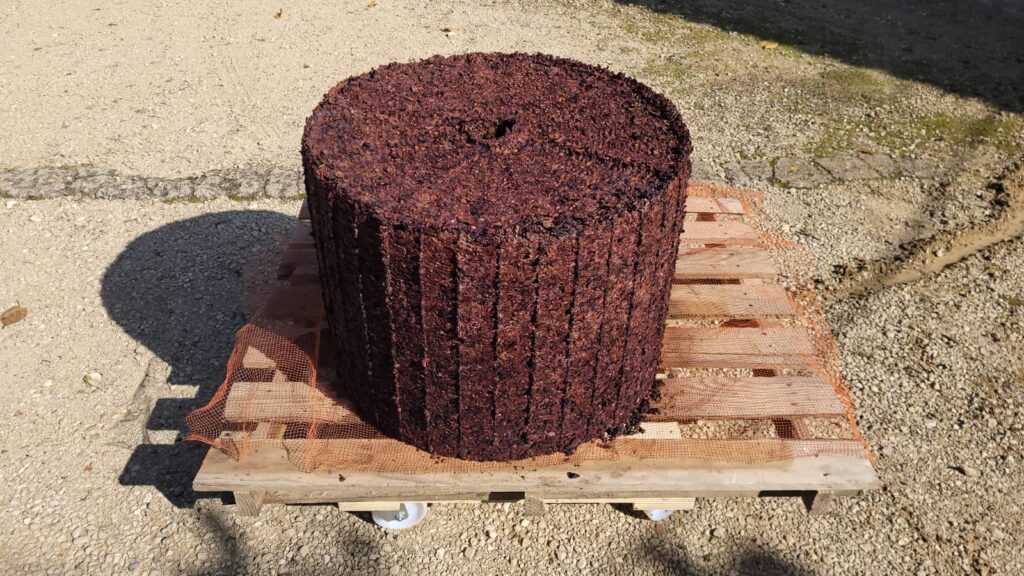
Within the hypogeum, where light, shadow and humidity generate a stratified ecosystem of plants, fungi and mosses, life emerges as a shared weave between matter and minute presences. It is within this dimension that Integratori, a site-specific work, takes shape, deepening the relationship between natural ecosystems, architecture and the garden as an instrument of biodiversity. Installed within the transept of the architectural cavity, the work assumes the form of a secular altar: pomace from the 2019 and 2020 harvests, compressed into linear volumes, becomes both sculpture and model, preserving the memory of an agricultural process thousands of years old that is now threatened by the industrial selection of species.
The temporary installation of the work becomes particularly significant because it transforms sculpture into an energetic cycle, converting residual agricultural materials into a critical matrix.
The artist’s work challenges monoculture, the reduction of biodiversity and the progressive transformation of the landscape into an agricultural monochrome, highlighting the ecological and cultural consequences of an impoverished territory. Through the compression, preservation and eventual return to the earth of pomace and stone pits, Integratori enters into the contemporary debate on post-nature, demonstrating how the living world has become inseparable from technical, economic and industrial processes. In this sense, the work enters into dialogue with artistic practices engaged in the ecological transformation of territory which, from bio-art and critical ecology to the genealogies of Land Art, share the conviction that sculpture can become an agent of regeneration, a gesture that does not represent nature, but reactivates it.
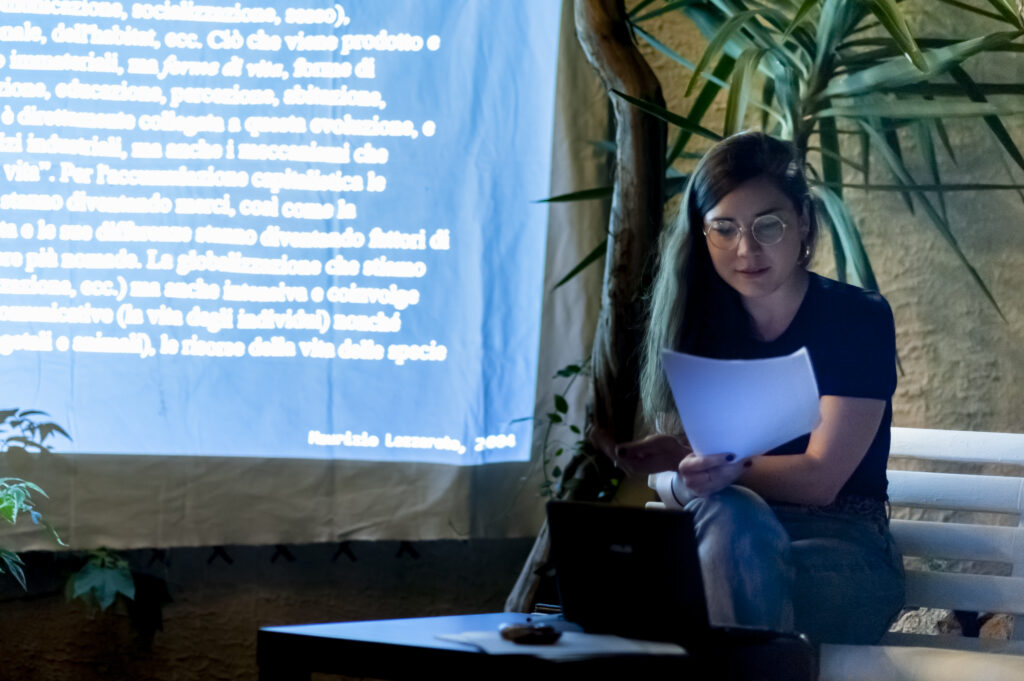
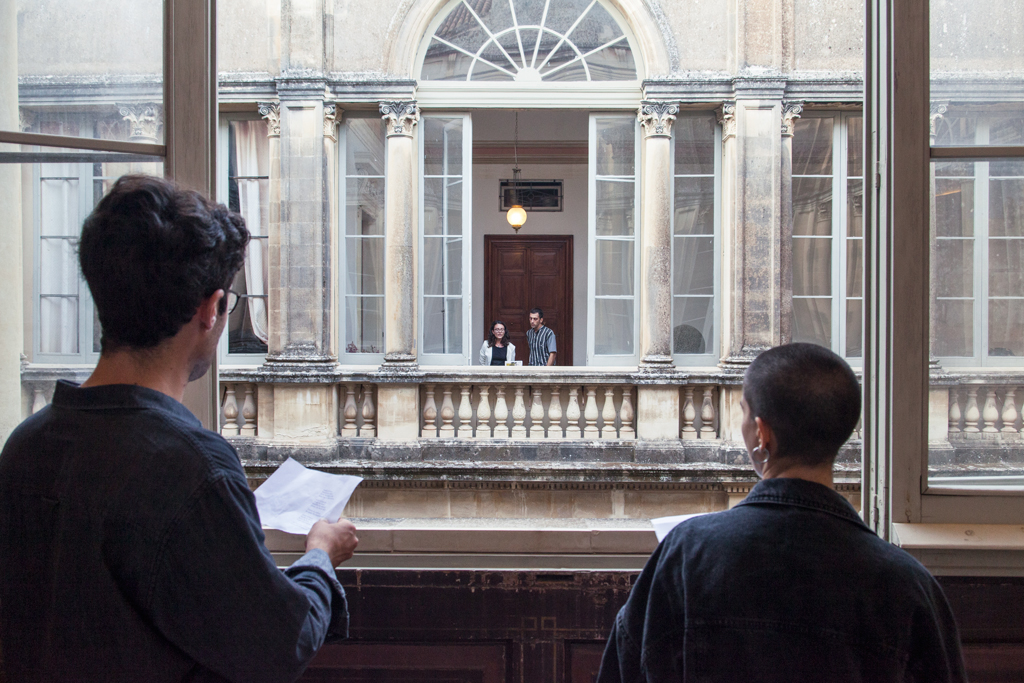
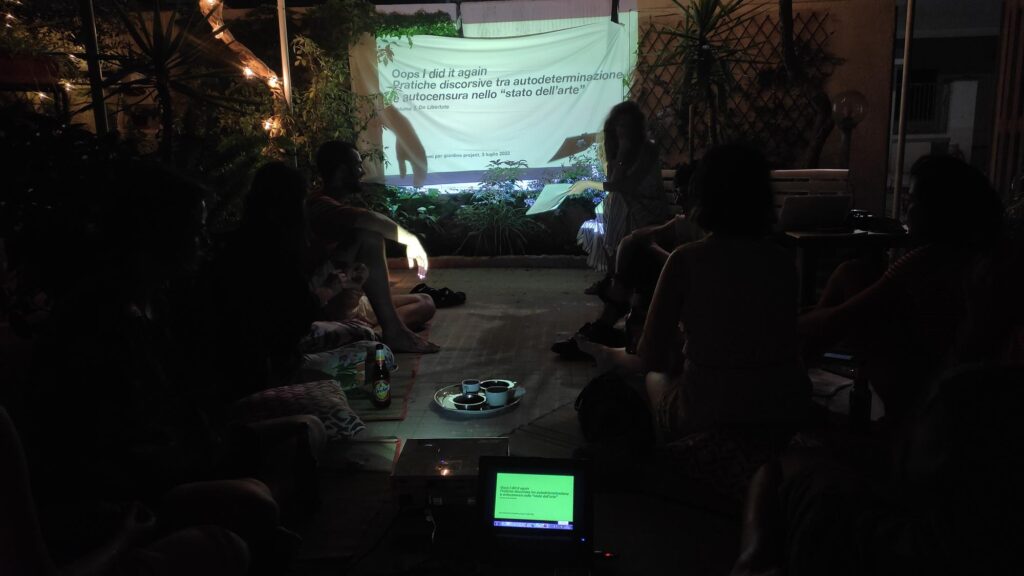
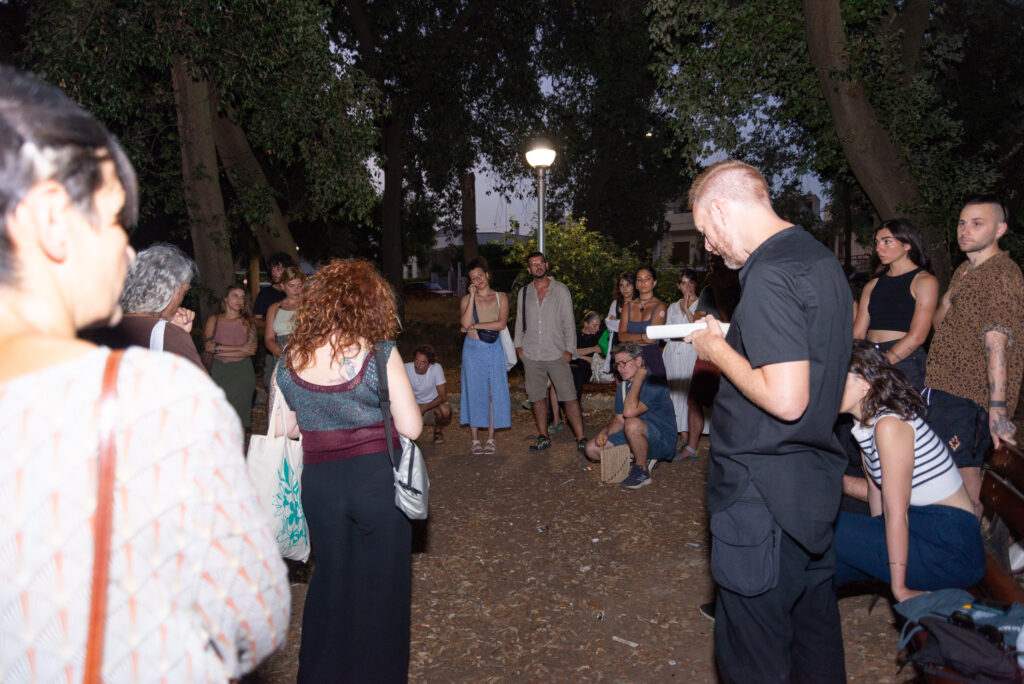
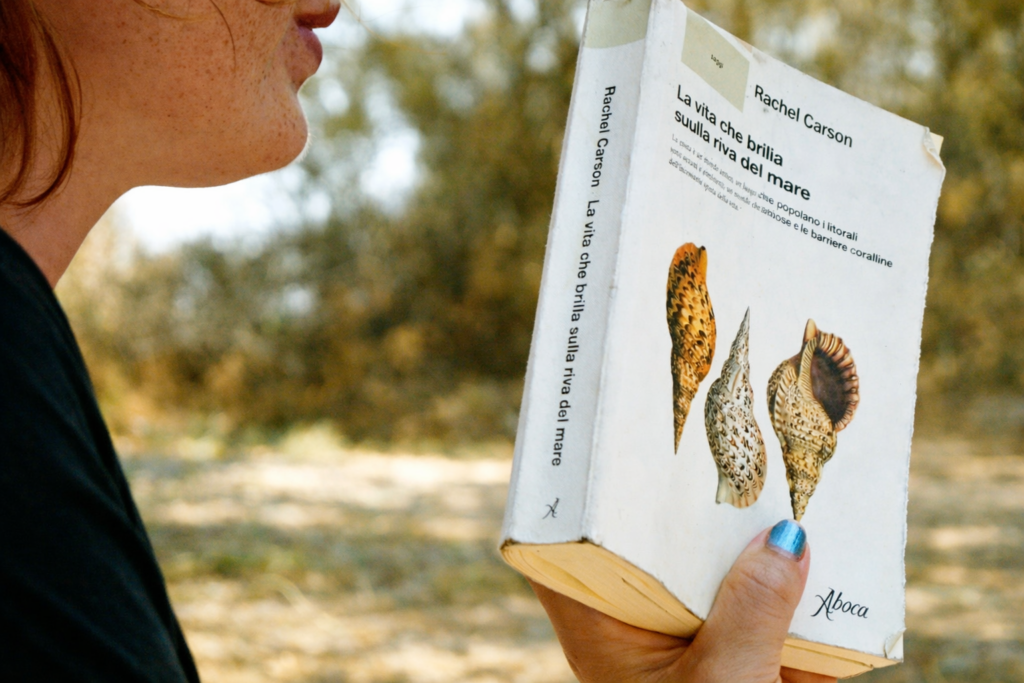
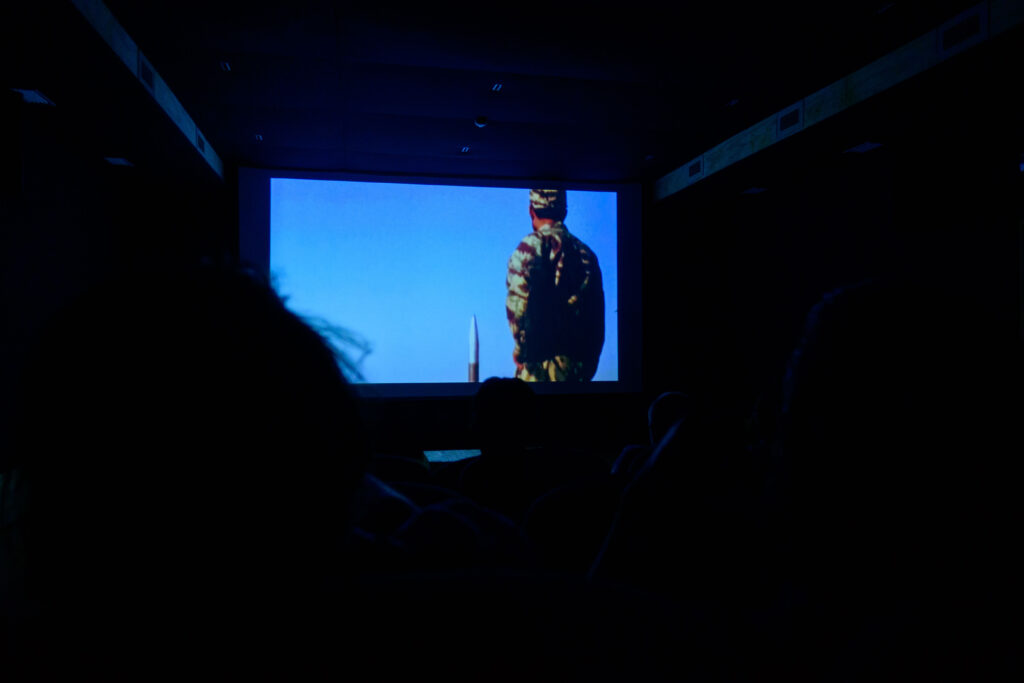
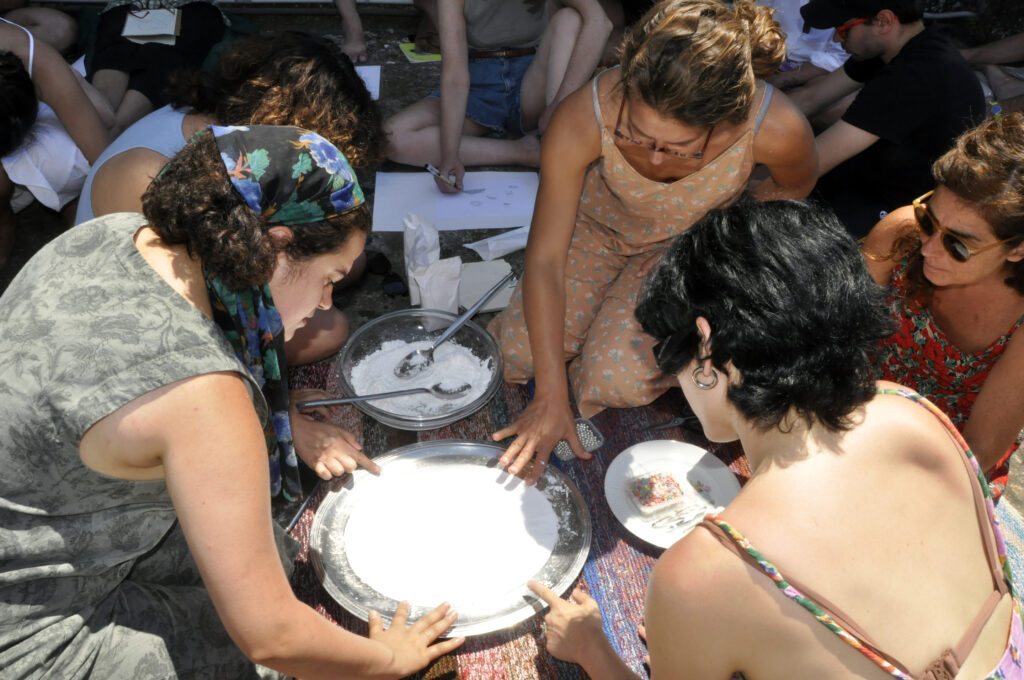
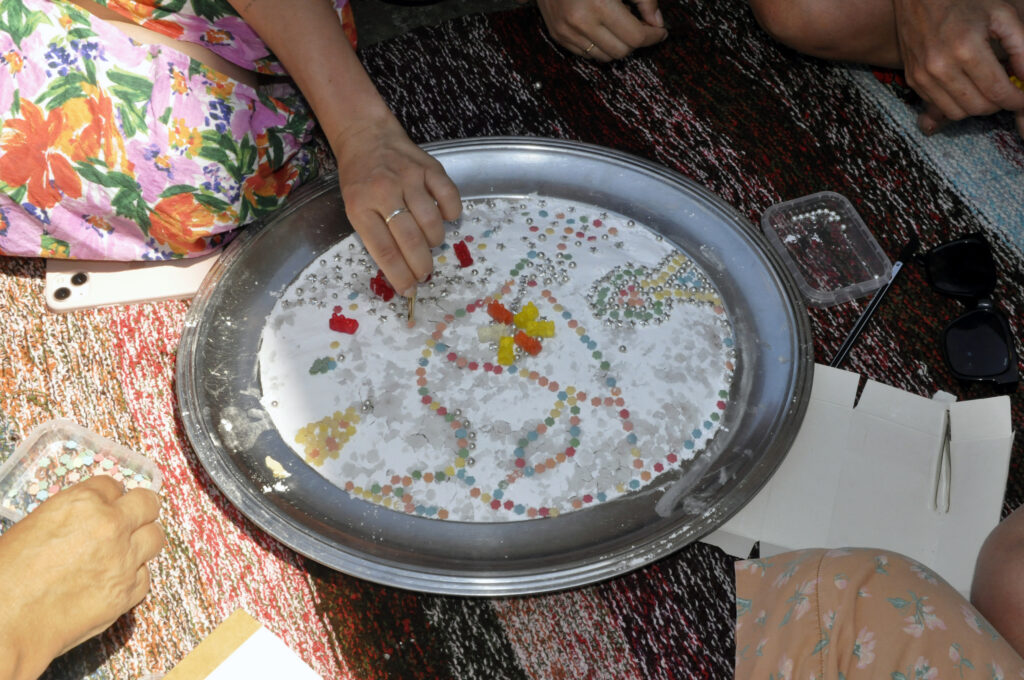
Volume 5. I feel a bit of sunshine when I see the marches all over the world supporting us (Noura Selmi). In collaboration with: Fondazione Merz and Fondazione Lac o Le Mon. Photo by giardino project
This trajectory will find its public and participatory form in Volume 6, Seed · Plant · Flower · Fruit, scheduled to take place on July 22 and 25 in Trepuzzi and Torre Pinta, near Otranto.
Credit: giardino project
All images: courtesy giardino project
For further information: giardinoproject.com
The Consolation of Familiar Terrors, ‘New Grotesque’ at Management

Near the end of the fifteenth century, a young explorer tripped and dropped through a hole into the buried chambers of Nero’s Domus Aurea, whose walls teemed with all types of impossible combinations: human limbs becoming foliage, animals dissolving into ornament, all of them uninterested in respecting the categories by which the world was ordinarily arranged. The rooms, long underground, had acquired the character of grottoes and the frescoes covering the walls were dubbed grottesche – from a cave. The word then migrated from the space to what inhabited it, and from there into something broader. Ever since, the grotesque has appeared with curious persistence whenever established orders begin to lose their authority, surfacing in moments when reality becomes crowded with competing fictions and contradictory truths.
Such conditions feel uncannily familiar today, in a world where carnivalesque authoritarianisms have become the new monsters and reality and fiction dissolve into an AI-generated broth, which perhaps explains the apt timeliness of New Grotesque, at Management, New York. Bringing together fifteen artists across generations, the exhibition unfolds as a dense ecology of mutations, doubles, apparitions and hybrid beings, establishing an anomalous world in which rationality and irrationality occupy the same address. If the grotesque has mutated through the endless circulation and amplification of images, the works in the show (through until 26th July) seem particularly attuned to what happens afterwards, once those images begin shedding their original contexts and acquiring unexpected new lives.
This traffic between visual worlds becomes especially compelling in the dialogue that emerges between Aleksandra Waliszewska and Jon Rafman. The former’s gouaches on paper draw from fairy tales, Symbolism and the dark logic of dreams; the latter’s images generate through contemporary technologies of simulation and image production. Yet both produce visions that seem detached from any stable origin, as if they had been circulating for much longer than their actual histories would allow.
The logic of improbable negotiations between the ordinary and the impossible recur throughout the exhibition. In Tura Oliveira’s epoxy and silver sculpture, Alien Martyr, Id Occupier (2026), two heads joined at the neck seemingly belong to different ontological registers: one almost elegant in its alienness, the other all exposed flesh and interiority, as though the creature’s hidden anatomy had turned outward. Sinister doubling evidently belongs to the grotesque’s engine and animates also Altmejd’s Smoking with Oneself (2021- 2026), extending the exhibition’s fascination with forms that refuse singular identities, rather preferring a paradoxical coexistence.
The exhibition does not miss addressing the psychopathological terrain of the present, excavating a wunderkammer of anxieties populated by ghosts from horror cinema, internet culture, religious iconography and fantasy illustration. Linda Marwan’s gremlinian mutants Chimeras (Tatzelwurm, Annalise), 2025 refuse to separate these references into neat categories. Emerging from a visual universe shaped by gaming culture and online aesthetics, they carry with them the unsettling familiarity characteristic of so much grotesque imagery. In Remake, reshoot, reprise: the world restarts with you, 2026 Andrew Roberts’ severed forearm, neatly packed inside a blue suitcase, introduces a more concrete register of horror. Drawing from histories of monstruosity while adhering to contemporary structures of violence, Roberts’ work evokes systems built upon militarised borders and the persistent spectres inhabiting the relationship between Mexico and the United States. A nod to the idea that the grotesque iconography has never existed independently of the worlds that produce it.
Other works expose the body in its fragilities, leaks, horrors, and desires, including Miriam Cahn’s drawings. Suspended between presence and disappearance, her eerie figures surface from the paper with an extraordinary economy of means. Amid the exhibition’s many mutations and transformations, they seem to exist almost as witnesses, observing a world in which categories have become increasingly porous and certainty increasingly difficult to maintain.
This porosity may be what ultimately binds New Grotesque together. The grotesque, after all, has never been merely a matter of distorted bodies or monstrous forms. Fringing the affections and desires of fandom, folklore and collective memory, this disquietingly effective exhibition engages with visible and invisible grotesqueries from different moments in cultural history and speculatively reanimates them. At the same time, it demonstrates that monsters per se are rarely the source of our unease. Far stranger are the conditions that produce them. Far stranger are the moments when fiction and reality begin exchanging masks.


New Grotesque
Management
David Altmejd
Tim Brawner
Miriam Cahn
Willehad Eilers
Christina Forrer
DD Herschlein
Linda Marwan
Tura Oliveira
Jang Pa
Jon Rafman
Andrew Roberts
Sibylle Ruppert
Igor Simic
Inna Smolina
Aleksandra Waliszewska
June 12 — July 26, 2026
Text by
Marco Galvan
Credits: Installation view Management. Courtesy of Management, New York.
Photo by Inna Svyatsky/installshots.art
When Objects Remember: Material Memory and Transformation in ‘La Rencontre du Troisième Type’
Bernard T. Sestig and Middernacht & Alexander explore memory, erosion and transformation at THE GET, Ghent.
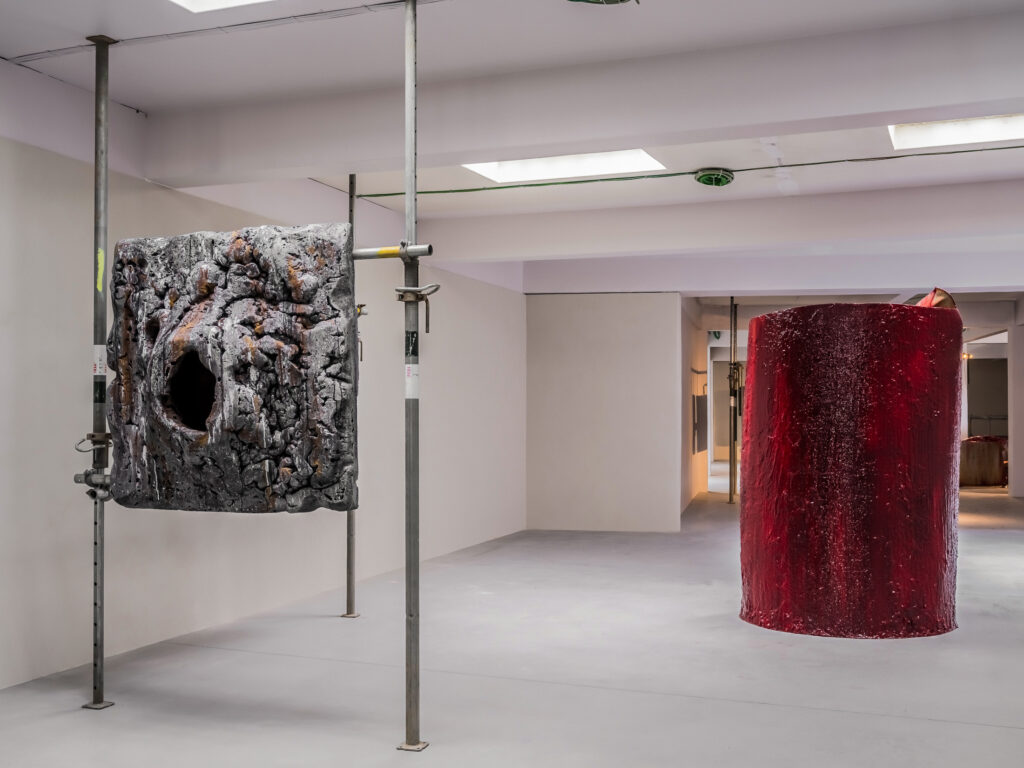
In an era increasingly defined by digital abstraction and ecological uncertainty, contemporary culture has developed a renewed fascination with materiality. Across art, architecture, and design, objects are no longer perceived merely as functional entities or aesthetic commodities; they have become repositories of memory, witnesses to industrial histories, and carriers of emotional and social narratives. The growing interest in reuse, preservation, and transformation reflects a broader cultural shift: a desire to reconnect with the physical world and to reconsider the traces left behind by human activity.
“The ruin creates the present form of a past life.”— Georg Simmel
It is within this context that La Rencontre du Troisième Type unfolds at THE GET, the newly inaugurated cultural space conceived by Belgian architect Glenn Sestig in Ghent. Bringing together Belgian multidisciplinary artist Bernard T. Sestig and the artistic duo Middernacht & Alexander, the exhibition explores the poetic and psychological potential of materials marked by time, tension, and transformation.
The title itself, La Rencontre du Troisième Type (“Close Encounter of the Third Kind”), suggests an unexpected meeting between different worlds. Here, that encounter takes place through matter: between sculpture and design, destruction and preservation, memory and reinvention. Rather than presenting distinct artistic practices side by side, the exhibition creates a dialogue in which each body of work amplifies the other, revealing shared concerns about fragility, permanence, and the invisible forces shaping contemporary life.
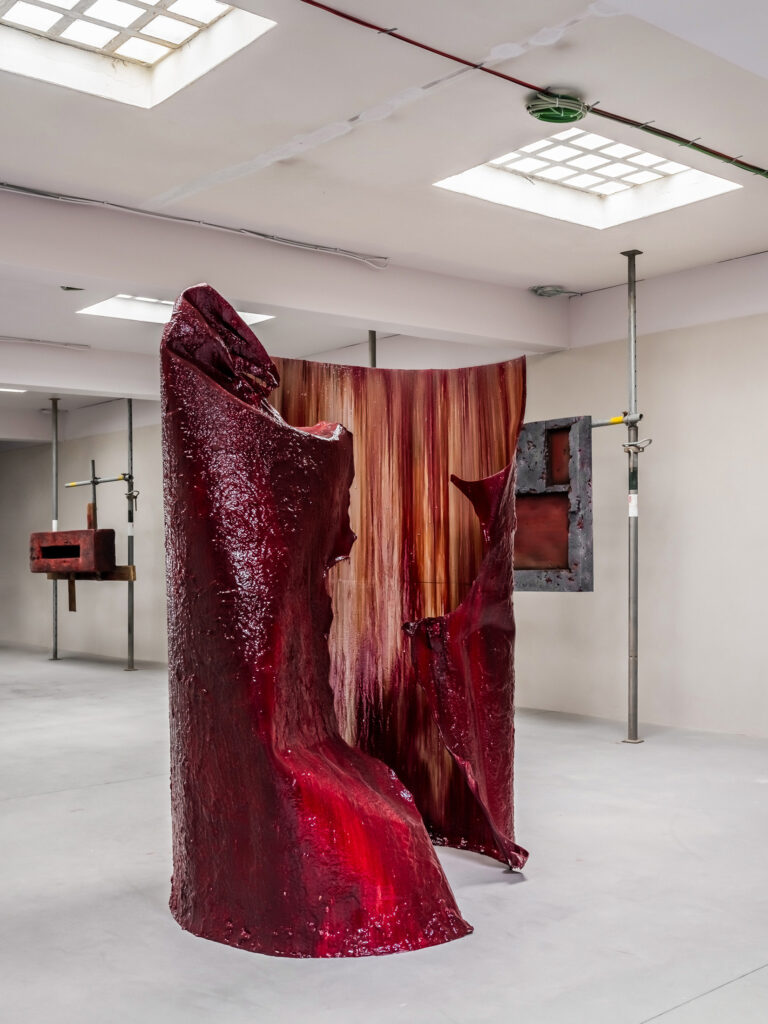
Bernard T. Sestig’s sculptures emerge as emotionally charged presences. Working across disciplines that include fashion, scenography, architecture, painting, and sculpture, Sestig has developed a language deeply rooted in material expression. His monumental forms evoke both geological remnants and bodily fragments, oscillating between attraction and discomfort. Embedded within their surfaces are references to environmental collapse, psychological tension, and the latent violence that often underpins modern systems of production and consumption.
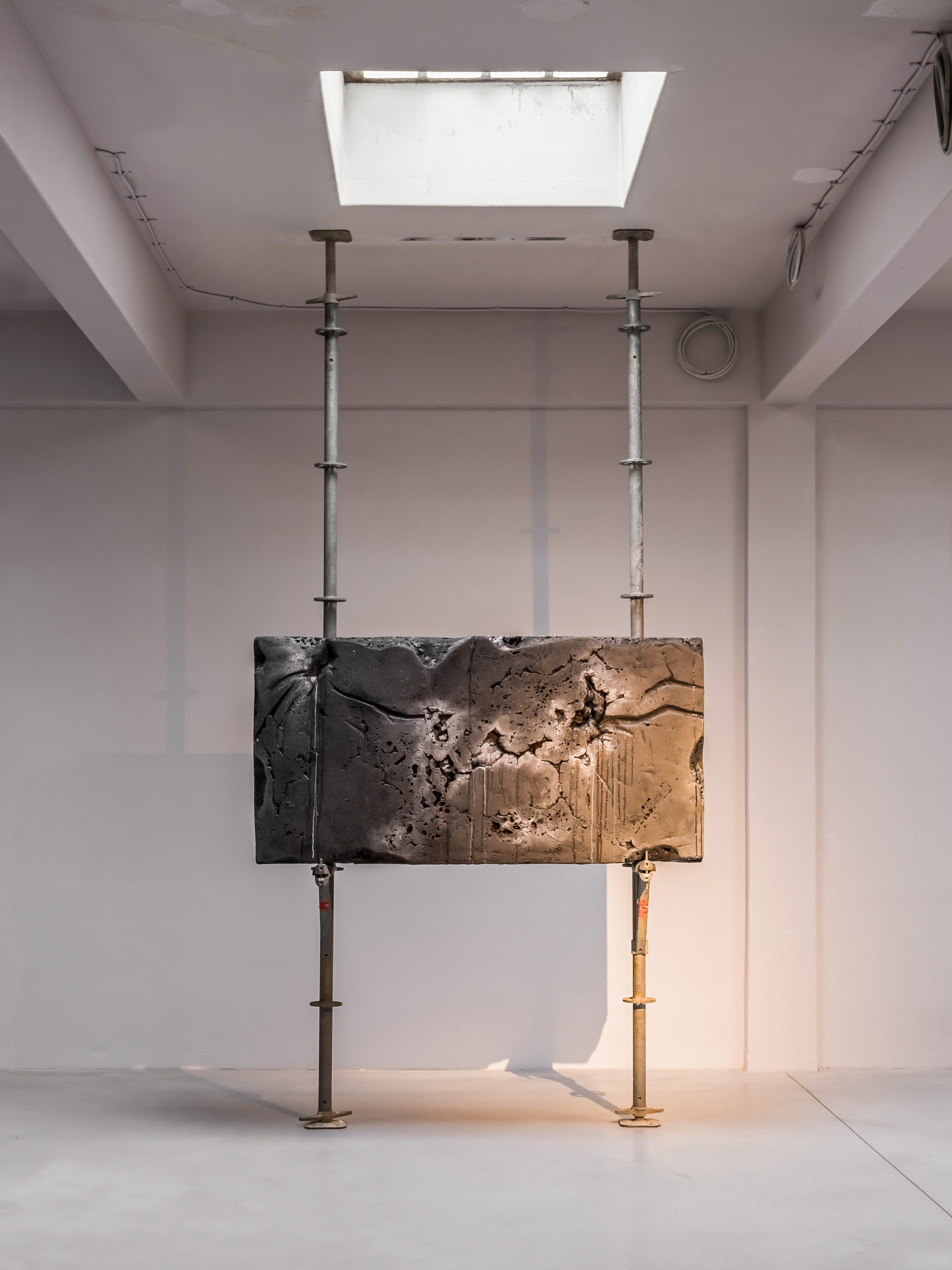
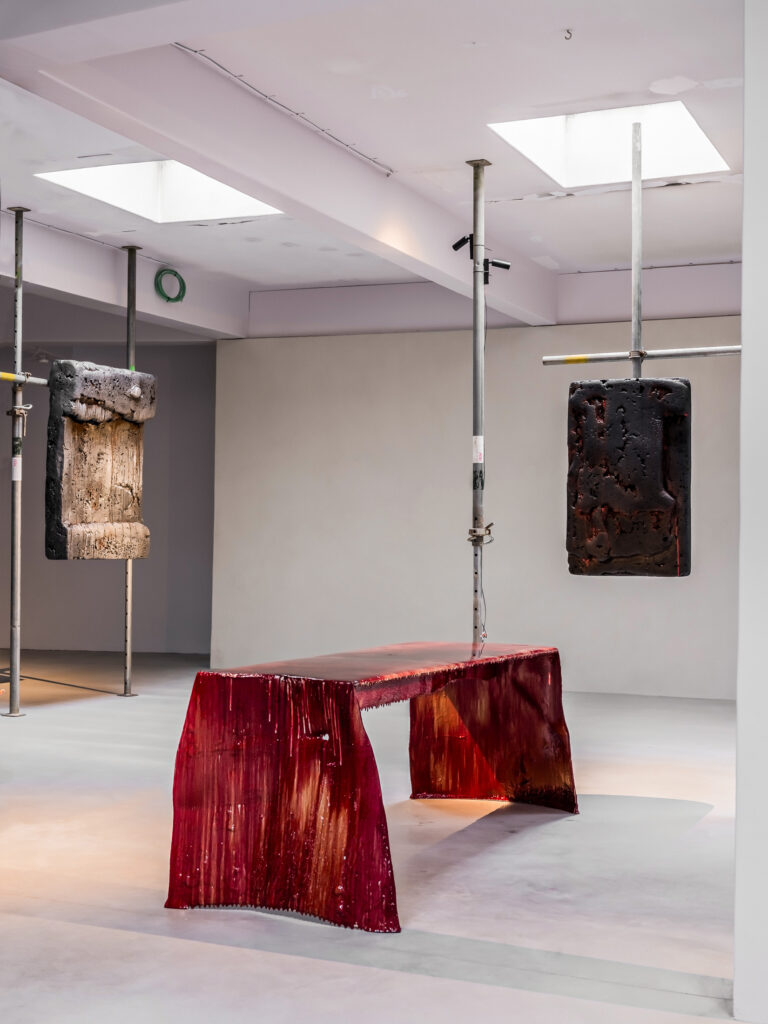
Opposite, yet profoundly connected, stands the work of Middernacht & Alexander. The Belgian duo has become internationally recognised for transforming decommissioned industrial oil tanks into collectible furniture and sculptural objects. Their practice operates through a process of recovery and recontextualisation, preserving corrosion, damage, and wear rather than erasing them. In doing so, they challenge conventional notions of value and beauty, inviting viewers to consider how objects accumulate histories and how those histories can be reactivated through design.
Together, the artists engage in a broader cultural conversation about the afterlife of materials. In a society increasingly concerned with sustainability, resource depletion, and environmental responsibility, their works resist the logic of disposability. Instead, they propose an alternative approach in which deterioration becomes meaningful and imperfection becomes a form of knowledge.
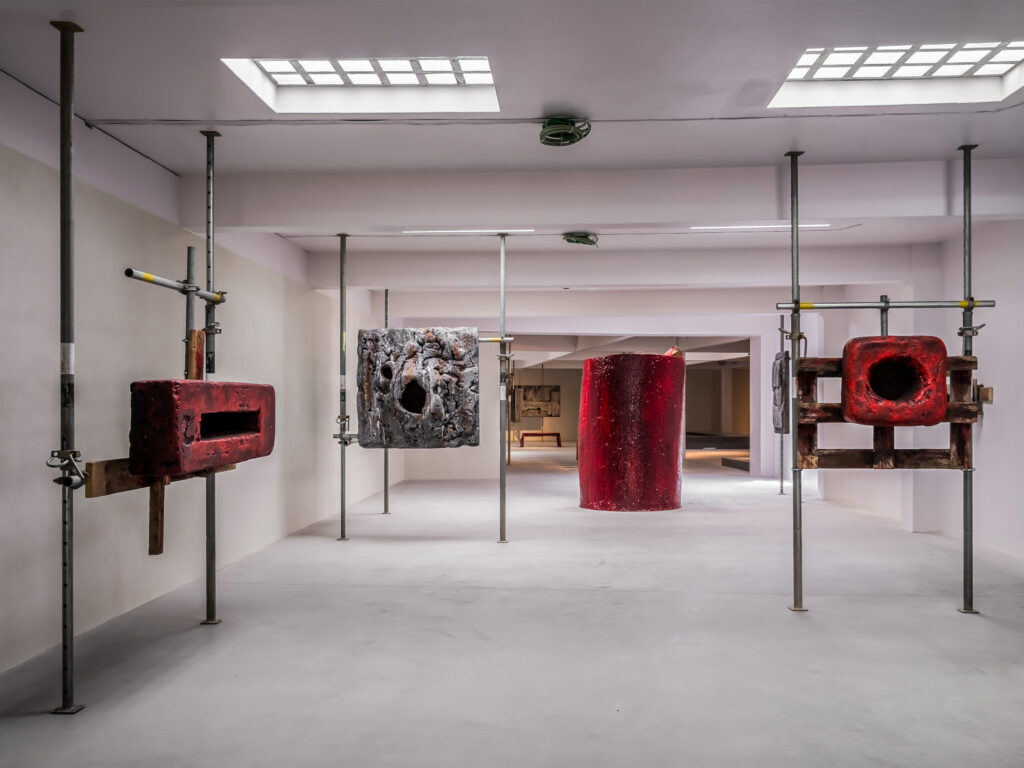
The architecture of THE GET plays a crucial role in this encounter. Designed by Glenn Sestig, whose practice is known for its rigorous spatial clarity and refined material sensibility, the venue functions not merely as a container for artworks but as an active participant in the exhibition. The open, minimalist environment heightens the physical presence of the sculptures while creating a contemplative atmosphere where visitors can experience the works as spatial and emotional events.
Curated by Fabian Jean Villanueva, whose practice operates at the intersection of art, design, fashion, and cultural storytelling, the exhibition avoids rigid disciplinary boundaries. Instead, it embraces hybridity, reflecting a contemporary cultural landscape in which distinctions between art, collectible design, architecture, and narrative continue to dissolve.
La Rencontre du Troisième Type is less about objects themselves than about the relationships they generate. It invites us to reconsider what materials remember, what histories remain embedded in surfaces, and how transformation can become an act of preservation rather than erasure.
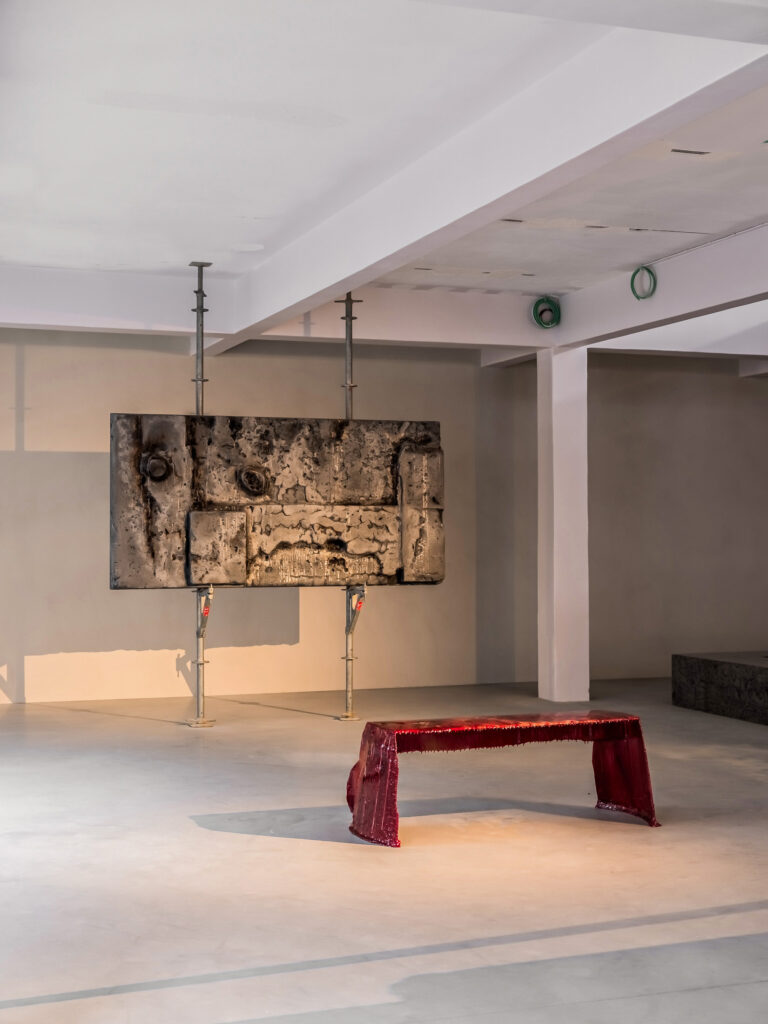
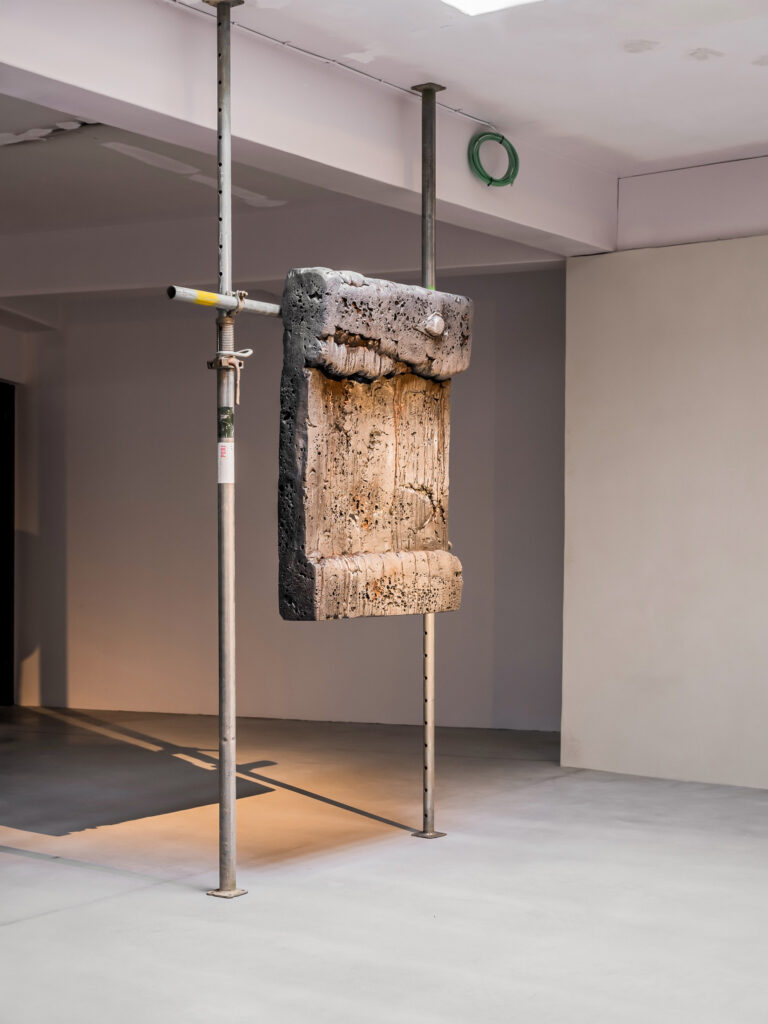
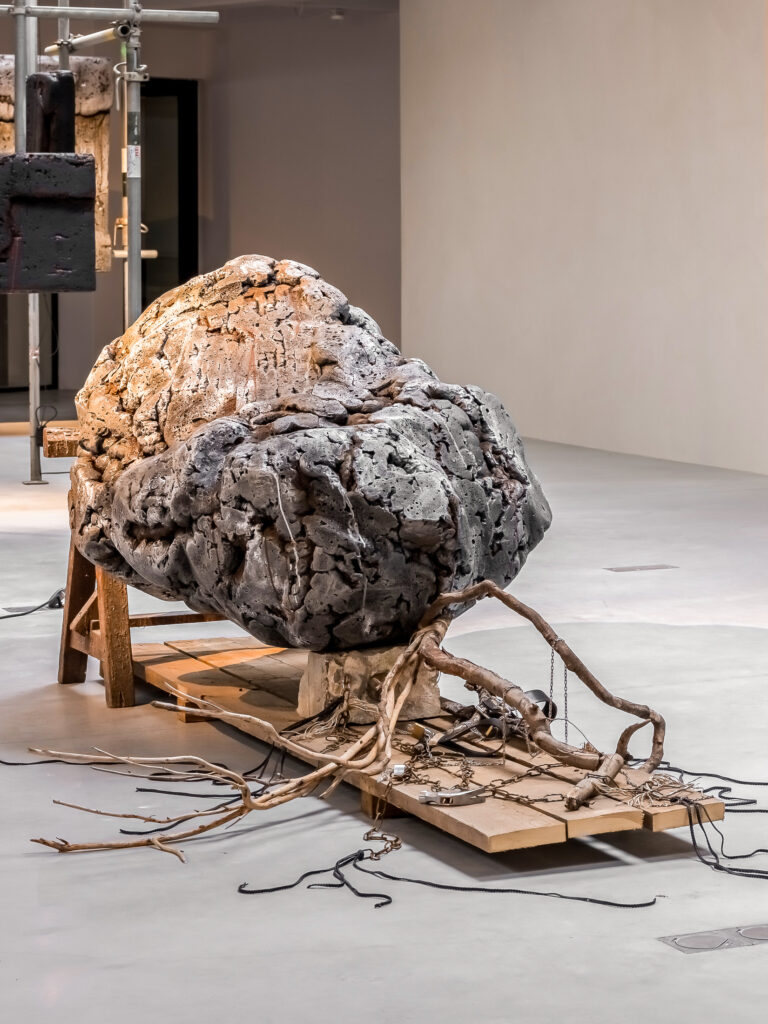
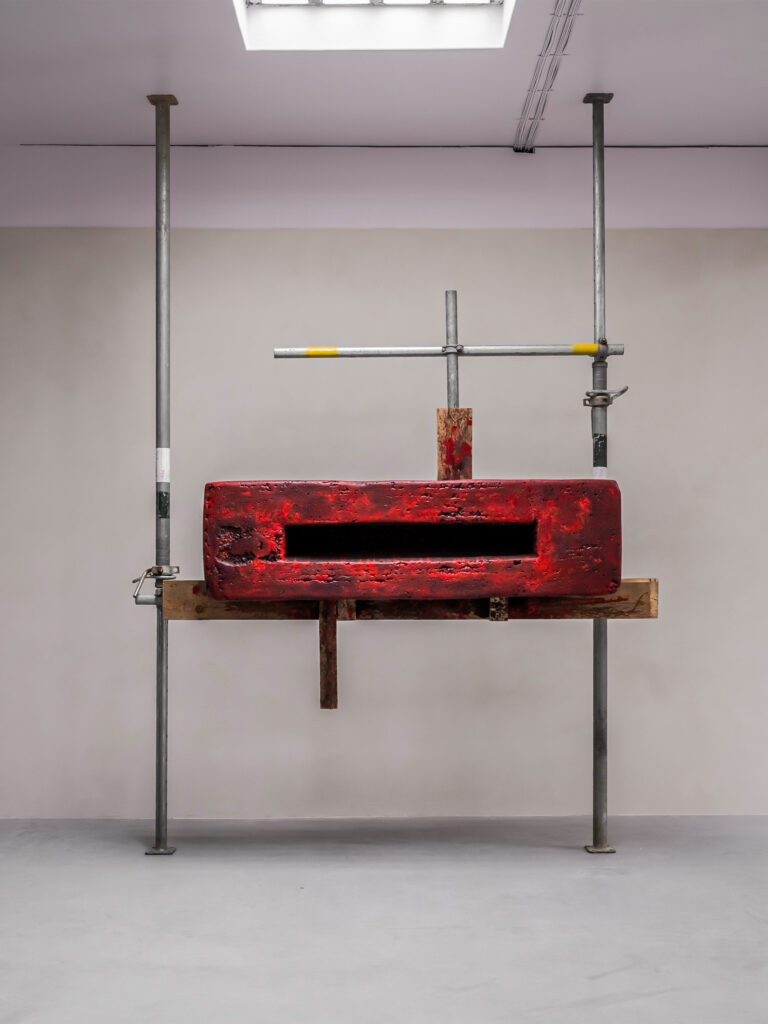
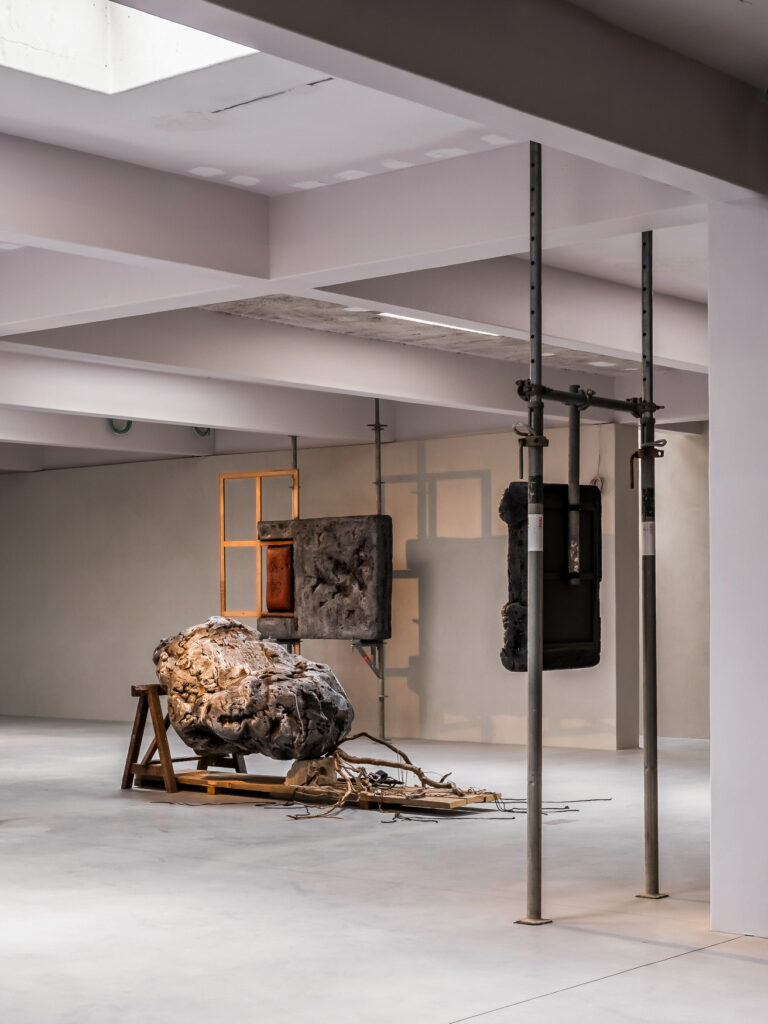
On view at THE GET in Ghent until 28 June 2026, La Rencontre du Troisième Type inaugurates a new cultural space while simultaneously opening a wider conversation about the future of material culture itself.
Curated by Fabian Jean Villanueva
Credit: Simone Lorusso
Photo by Cafeine
UKURANT ‘Makes Room’ at 3daysofdesign: Copenhagen Opens Space for Emerging Design
During 3daysofdesign 2026, the Danish exhibition platform returns with its fifth edition, bringing together 26 young designers at Fabrikken for Art & Design.

Every generation of designers inherits a language that has already been written. Forms, materials, production processes and aesthetic codes make up a shared cultural vocabulary that, in order to remain alive, must be constantly questioned, challenged and rewritten. It is precisely within this space of tension between tradition and experimentation that UKURANT Makes Room takes shape: the fifth edition of the Danish exhibition platform dedicated to the new generation of contemporary design.
“To design is always to redesign.”— Bruno Latour
From 10 to 12 June 2026, as part of 3daysofdesign in Copenhagen, UKURANT will transform the spaces of Fabrikken for Art & Design into an open laboratory of ideas, materials and design practices. Over the years, the platform has become one of the most compelling observatories for understanding the emerging directions of international design.
Founded in 2019 to give young designers an experimental platform within the established design scene, UKURANT has built a creative community where research, production and experimentation can enter into dialogue. The 2026 exhibition brings together 26 designers from around the world, each presenting work that explores new perspectives on what it means to make design today through unconventional materials, processes, concepts and methods.

The title of this edition, “Makes Room”, is not only a curatorial statement but also a cultural position. To make room means to create the conditions for new voices to emerge, to welcome the uncertainty of research and to recognise the value of process beyond the finished object. The works on view draw from inherited traditions and established knowledge, while testing their limits through new approaches to making and production.
At a time when design is increasingly called upon to respond to complex environmental, social and industrial questions, UKURANT offers a reflection on design as an open and critical practice. The selected works address materiality, sustainability, contemporary craftsmanship and the possibilities offered by new production processes, opening up a broader discussion around the systems that shape commercial and cultural design today.
The selection of Fabrikken for Art & Design as an exhibition venue is a perfect illustration of this idea too. Once an industrial factory, today a space for creative activities and meetings between artists, designers, and others, Fabrikken represents a true place of community that shares the very same principles as UKURANT does.

The exhibition design also plays an essential role in the curatorial project. Large paper podiums occupy the factory hall, creating a neutral landscape on which each work can unfold its own narrative. Built from rented stage platforms, the spatial design responds to the scale of the architecture while limiting the use of new materials, combining sustainability with a considered approach to display.
Particular attention is also given to the processes behind the works. Alongside objects and installations, visitors will encounter design decisions, material tests and experiments that usually remain behind the scenes. The exhibition invites the public to understand design not only as a finished result, but as a journey shaped by research, trials, labour and care.

Curated and designed by UKURANT’s founders Kasper Kyster, Josefine Krabbe, Kamma Rosa Schytte and Lærke Ryom, the exhibition enters the 3daysofdesign programme as one of the key moments dedicated to emerging research. In a city that, for several days, becomes an international centre for contemporary design discourse, UKURANT confirms the role of younger generations as a force for innovation, critical imagination and cultural renewal.


UKURANT Makes Room
10–12 June 2026
Fabrikken for Art & Design, Sundholmsvej 46, Copenhagen
Credit: Simone Lorusso
Photo by Maya Matsuura
Chiara Camoni Weaves Matter, Memory and Landscape at Fondazione Zegna
A site-specific exhibition where sculpture, weaving and natural materials intertwine, tracing new connections between landscape, craftsmanship and collective memory.

Just a few weeks before the opening of the 61st International Art Exhibition – La Biennale di Venezia, where Chiara Camoni represents Italy with the project Con te con tutto, curated by Cecilia Canziani and supported by ZEGNA as Main Sponsor, the exhibition emerges from a relationship cultivated over time, in which the landscape of Oasi Zegna, the memory of manufacturing, and the artist’s research appear to belong to the same sensitive geography.
Conceived in close dialogue with the landscape of the Oasi, Luccicanza. Di fiori e di filo, di pietra e di terra, di pelle e di radice stems from a profound affinity between the artist’s practice and the cultural vision promoted by Fondazione Zegna and ZEGNART, the framework that brings together ZEGNA’s artistic initiatives. A vision in which art, nature, craftsmanship and landscape do not appear as separate realms, but as parts of a shared cultural and material fabric, capable of evolving over time through relationships, processes and layers of meaning.
On view at Casa Zegna until 22 November 2026, the exhibition curated by Ilaria Bonacossa unfolds as a habitable landscape, an environment in which sculpture, weaving, ceramics and natural matter intertwine in a network of correspondences between the human body, the memory of places and forms of living existence. The project is complemented by the reinstallation of Untitled, Stabkarte (2014) in the Chapel of San Rocco in Trivero.
Within the artist’s practice, matter is never a neutral support, but a living, mutable presence, capable of holding memory and metamorphosis. Earths, minerals and plant fibres sourced from the Oasi Zegna territory, together with yarns from Lanificio Zegna, enter the works as active elements, generating forms that seem to emerge gradually from the landscape itself. The title of the exhibition, Luccicanza, evokes precisely this intermittent quality of matter: a fragile, almost organic glimmer that moves across surfaces, colours and textures, like a spark appearing at the point of encounter between different elements.
In the artist’s practice, the creative gesture coincides with a process of listening and proximity. The work takes shape through slow processes, sedimentations and gradual transformations, in which artistic making retains something of the artisanal dimension of the workshop and of knowledge passed down through generations.
“I do not wake up with unprecedented ideas: it is the work I have just completed the day before that sets in motion what I begin to develop the day after.” – Chiara Camoni
The works presented throughout the spaces of Casa Zegna enter into dialogue with the architecture of the winter garden designed by Pietro Porcinai, now repurposed as an exhibition space. Its glass walls allow the surrounding landscape to permeate the interior and become an integral part of the display: Casa Zegna thus becomes the ideal setting for Chiara Camoni’s practice, which is deeply invested in exploring the intersections between nature and culture.
The installation is composed of a variety of elements — vessels, figures, carpets, textile surfaces and architectural sculptures — that transform the exhibition space into a habitable environment, both welcoming and uncanny at once, inviting visitors to become active participants in the experience. As Chiara Camoni explains: “The works ask the viewer to be present with their body and to establish a relationship with that other body, which is the sculpture. Something happens in that encounter, but it is not an intellectual relationship.” This relational dimension resonates with the very philosophy of Fondazione Zegna, which has long fostered an ongoing dialogue between culture, territory and community.
The vessels, figures, carpets and textile surfaces are created using materials sourced directly from the Oasi Zegna territory: earths, minerals, plant fibres and yarns. In many cases, colour is not applied by the artist but emerges from the intrinsic properties of the material itself, which, when subjected to high temperatures, vitrifies, becoming a true physical transposition of the landscape.
The artist’s entire practice is guided by a desire for discovery: materials are not neutral tools, but active interlocutors, capable of guiding and transforming the creative process. Camoni is interested in the generative dimension of the earth, while remaining distant from any idealised or romantic vision of nature.
Beyond the spaces of the Oasi, the exhibition extends into the Chapel of San Rocco in Trivero with Untitled, Stabkarte, a work composed of a series of threads suspended on the wall, each formed by hundreds of small hand-modelled shapes in different earth tones. Created in 2014 on commission from ZegnArt, the work marks one of the earliest encounters between the artist and the landscape of Oasi Zegna, anticipating themes that have since become central to her practice: the metamorphosis of matter, the processual nature of making, and the relationship between gesture, memory and landscape.
Chiara Camoni’s exhibition for Fondazione Zegna unfolds as a secret garden to be traversed slowly, a space where the landscape enters the artwork and the artwork, in turn, seems to give voice back to matter. In Luccicanza, every element — a thread, a stone, a leaf, a figure — participates in the same network of relationships, making visible that fragile and intermittent spark that runs through all things and which the artist calls, precisely, luccicanza.
The exhibition is now on view at Casa Zegna through November 22.


Credits: Exhibition view, Luccicanza. Di fiori e di filo, di pietra e di terra, di pelle e di radice at Casa Zegna.
Curated by Ilaria Bonacossa
Photo by Camilla Maria Santini
CHIARA CAMONI
Chiara Camoni (1974, Piacenza) lives and works in a small village nestled in the Apuan Alps. She is the artist representing Italy at the 61st International Art Exhibition – La Biennale di Venezia 2026 with the project Con te con tutto, curated by Cecilia Canziani. Her practice encompasses drawing, botanical printing, video, and above all sculpture, with a particular focus on ceramics. Her works are often the result of collaborations with informal and spontaneous groups, as well as more institutional workshops and seminars. For several years, Il Centro di Sperimentazione has supported the artist in the development of projects characterised by a shared authorship, further expanding the formats and languages she employs in her practice.
FONDAZIONE ERMENEGILDO ZEGNA | PROMUOVERE UN FUTURO MIGLIORE
Fondazione Ermenegildo Zegna’s mission is to help create a better future for the next generations. Inspired by the ethic of giving back to the community that guided its founder from as early as 1910, the third generation of the Zegna family established the Foundation in 2000 to carry forward the philanthropic legacy it had inherited. Following the founder’s vision and the path he charted, quality and dedication exist in harmony with the protection of the natural environment, social well-being, and cultural development.
CASA ZEGNA | DIVULGARE VALORI
Since 2007, Casa Zegna has been an integral part of Fondazione Ermenegildo Zegna, preserving and promoting the heritage and values of the Zegna Group, whose roots lie in the vision of its Founder. Casa Zegna’s multifunctional space encompasses archives dedicated to the preservation and dissemination of more than 110 years of style and responsible entrepreneurship, textile sample collections, and exhibition spaces devoted to projects commissioned from contemporary artists. Casa Zegna represents the roots of Zegna, a place where visitors can retrace the path envisioned by the Founder towards the future.
A Cybernetic Sanctuary by Lu Yang at Espace Louis Vuitton Venezia
Through AI-generated imagery, immersive installation and the virtual avatar DOKU, Lu Yang explores identity, reincarnation and the boundaries of the digital body.

In parallel with the 61st International Art Exhibition — La Biennale di Venezia, marking the 20th anniversary of the Espaces Louis Vuitton and the 10th anniversary of the Fondation Louis Vuitton Hors-les-murs programme, the Espace Louis Vuitton Venezia presents DOKU The Illusion, a solo presentation by Chinese-born artist Lu Yang curated by Claire Staebler, on view from May 8 — October 4, 2026.
This exhibition is part of the Hors-les-murs programme, embodying the Fondation Louis Vuitton’s mission to mount international projects and reach a broader global audience through exclusive exhibitions at the Espaces Louis Vuitton in Tokyo, Munich, Venice, Beijing, Seoul and Osaka.
Represented by SOCIÉTÉ, Lu Yang has established a strong presence on the international art scene through the creation of virtual worlds presented as immersive video installations. His imagined universes — often marked by post-apocalyptic undertones — are grounded above all in Buddhist philosophy, engaging concepts such as dreams and waking, illusion and awakening, and the Madhyamaka inquiry into intrinsic nature. This philosophical framework intersects with a broader investigation into the structure of reality in the digital age.
Manga, video games and anime — contemporary visual idioms adopted by Lu Yang — function primarily as a formal vocabulary rather than as the conceptual foundation of his work. Through this visual grammar, the artist brings forth hybrid entities that move beyond fixed categories of identity and embodiment, opening a space to reflect on what it means to be human in the 21st century.


For his exhibition at the Espace Louis Vuitton Venezia, Lu Yang has created an installation featuring original sculptures and a video work centred on his new film DOKU The Illusion, the fourth chapter in the DOKU series, an ambitious narrative project the artist began in 2019. DOKU is a virtual character based on the digitalisation of the artist’s own face. The series depicts the solitary adventures of this multifaceted avatar, through which Lu Yang transcends the limits of the physical body and explores new forms of freedom through digital reincarnation.
The installation created by Lu Yang transforms the Espace Louis Vuitton Venezia into a cybernetic sanctuary, situated somewhere between a chapel and a futuristic refuge. At its core, the film DOKU The Illusion can be seen on a monumental LED screen, placed on an altar. This chapter is the series’ fourth instalment after The Self (2022), The Flow (2023), and The Creator (2025), and blends live-action footage with AI-generated imagery. It primarily unfolds against a backdrop of the deep-blue skies and expansive landscapes of Japan’s Izu Peninsula, forming a veritable road movie.
Taken in an immersive environment, visitors are greeted by two sculptures of Buddha holding the wheel of life, the eternal symbol of the cycle of existence. Thanks to a mirrored ceiling reflecting a floor that is characteristic of Venetian architecture, each visitor becomes part of the experience, their projected silhouette integrated into the installation itself for a liminal moment in time in which contemplation and dissolution merge and mirror, echoing the Buddhist quest for enlightenment.
Within this sanctuary-like space, the visitor watches DOKU hurtling along in a red vehicle, a symbol of freedom. The soundtrack — a blend of hip-hop, piano and traditional music — harmonises exquisitely with the voices, intimate narratives and palpable vibrations, reflecting the theme of the 61st International Art Exhibition — La Biennale di Venezia, In Minor Keys.


Lost In Venice: Notes On A Biennale Without Direction
From fractured narratives and subdued atmospheres to institutional tension and political unrest, In Minor Keys unfolds as a Biennale suspended between poetic ambition and curatorial disorientation.

In Minor Keys is a Biennale conceived, in keeping with curator Koyo Kouoh’s vision, in a minor register. It turns away from the monumental and declarative modes traditionally associated with the large-scale international exhibition in order to embrace quieter, more oblique, and more nuanced forms of listening, relation, attentiveness to excluded genealogies, and slower temporalities. With its overt borrowing from musical vocabulary, the title announces an anti-heroic curatorial stance: an exhibition that privileges introspection, reflection, and a sensitive attunement to the world — and above all to its margins — over the construction of emphatic statements. Yet this very premise, compelling as it is in theory, seems to have produced, at least in part, a Biennale that feels restrained.
It should be acknowledged that In Minor Keys had to contend with a decisive absence: the death of Koyo Kouoh in 2025, after she had already defined the exhibition’s title, artists, theoretical framework, and overall structure, which was subsequently carried forward by the team that continued her work. But it would be too easy to read the exhibition simply as a project maimed by fate, or as the inevitably incomplete outcome of a vision cut short. Mourning matters, and it matters profoundly. Still, it does not fully account for the sense of discontinuity and disorientation that accompanies one’s passage through the Giardini and the Arsenale.
The promise of a quieter, more oblique approach — conceived as an active contribution to world-making, and perhaps also as a form of resistance and renewal in difficult times — immediately struck me as compelling, not least because it seemed so necessary in a present marked by violence, polarization, and ongoing trauma. Yet in the end, this minor key is never fully realized in the exhibition. Instead, it gives way to a curatorial weakness that leaves the show less incisive, as its dispersal of focus produces not complexity so much as confusion.
If one wants to draw from this exhibition a reflection that extends beyond the field of art, one is led to ask whether, in a present dominated by forceful positions, openly declared conflicts, and crises that demand continual acts of alignment, a counterproposal grounded in a different posture can truly hold. Perhaps the point is precisely that In Minor Keys registers a genuine need of our time: the desire to step outside the regime of things as they are, beyond spectacularization, rhetoric, incessant enunciation, and the assumption that relevance must necessarily coincide with force. Yet it is precisely in attempting to inhabit this alternative posture at the curatorial level that the exhibition encounters difficulty, never fully translating it into a convincing spatial and formal language. As a result, the intuition from which the entire project emerges remains more persuasive as a theoretical proposition than as an actual exhibition experience.
At the Giardini, In Minor Keys opens with Otobong Nkanga’s intervention on the exterior columns of the Central Pavilion, clad in brick, glass terrariums, terracotta vessels, and bee shelters, as if vegetal and organic matter might slowly insinuate itself into the modernist order of the architecture. By acting upon the building’s monumental character, the work seems to suggest that even a platform like the Biennale — a paradigmatic site of power, Eurocentric in structure, a machine of visibility and consecration — might be traversed by other forms of life, other temporalities, another way of inhabiting space. In this sense, it offers a perfect premise.
The exhibition then unfolds through two relatively successful opening rooms. In the first, Seyni Awa Camara’s sculptures are especially striking. The heir to a long lineage of potters from Lower Casamance, Senegal, Camara populates the space with beings of silent intensity. Neither fully animal nor fully human, with protruding eyes and broad, flat feet, these figures seem to inhabit a threshold between dream and wakefulness.
In the second room, María Magdalena Campos-Pons’s large-scale tribute, Anatomy of the Magnolia Tree for Koyo Kouoh and Toni Morrison (2026), emerges as one of the most declarative yet also most emotionally calibrated works in the exhibition’s opening sequence. Large vertical panels form a kind of paper mural in which the figure of Koyo Kouoh, wrapped in a long dark mantle, appears beside Toni Morrison. Between them, magnolia branches rendered in watercolor, ink, and gouache spread across the wall like a vegetal weave that is at once fragile and solemn.

The magnolia, emblematic of the American South, reappears before the mural in the form of floral sculptures in glass and resin, arranged on pedestals like votive presences. A sound composition by Kamaal Malak, built from bass frequencies and synthesizers, completes the installation. The work thus makes explicit its homage to Black women whose interiority, memory, and transmission of knowledge became forms of cultural and intellectual force.In Minor Keys is a Biennale conceived, in keeping with curator Koyo Kouoh’s vision, in a minor register. It turns away from the monumental and declarative modes traditionally associated with the large-scale international exhibition in order to embrace quieter, more oblique, and more nuanced forms of listening, relation, attentiveness to excluded genealogies, and slower temporalities. With its overt borrowing from musical vocabulary, the title announces an anti-heroic curatorial stance: an exhibition that privileges introspection, reflection, and a sensitive attunement to the world — and above all to its margins — over the construction of emphatic statements. Yet this very premise, compelling as it is in theory, seems to have produced, at least in part, a Biennale that feels restrained.
It should be acknowledged that In Minor Keys had to contend with a decisive absence: the death of Koyo Kouoh in 2025, after she had already defined the exhibition’s title, artists, theoretical framework, and overall structure, which was subsequently carried forward by the team that continued her work. But it would be too easy to read the exhibition simply as a project maimed by fate, or as the inevitably incomplete outcome of a vision cut short. Mourning matters, and it matters profoundly. Still, it does not fully account for the sense of discontinuity and disorientation that accompanies one’s passage through the Giardini and the Arsenale.
The promise of a quieter, more oblique approach — conceived as an active contribution to world-making, and perhaps also as a form of resistance and renewal in difficult times — immediately struck me as compelling, not least because it seemed so necessary in a present marked by violence, polarization, and ongoing trauma. Yet in the end, this minor key is never fully realized in the exhibition. Instead, it gives way to a curatorial weakness that leaves the show less incisive, as its dispersal of focus produces not complexity so much as confusion.
If one wants to draw from this exhibition a reflection that extends beyond the field of art, one is led to ask whether, in a present dominated by forceful positions, openly declared conflicts, and crises that demand continual acts of alignment, a counterproposal grounded in a different posture can truly hold. Perhaps the point is precisely that In Minor Keys registers a genuine need of our time: the desire to step outside the regime of things as they are, beyond spectacularization, rhetoric, incessant enunciation, and the assumption that relevance must necessarily coincide with force. Yet it is precisely in attempting to inhabit this alternative posture at the curatorial level that the exhibition encounters difficulty, never fully translating it into a convincing spatial and formal language. As a result, the intuition from which the entire project emerges remains more persuasive as a theoretical proposition than as an actual exhibition experience.
After these first two rooms, however, the exhibition seems to slip into visual overload, into an accumulation of works that gives way to increasing indeterminacy. There is certainly no shortage of compelling works, nor of themes. And yet one is left with the sense of an exhibition in which it becomes difficult to grasp the thread, an exhibition whose considerable richness is not always matched by an equally lucid formal articulation.
The Arsenale, by contrast, finds a stronger rhythm. Already at the entrance, Refaat Alareer’s text lends the exhibition a political gravity that is difficult to evade. The words accompanying In Minor Keys—“the songs of those who continue to generate beauty despite tragedy, the melodies of fugitives resurfacing from ruins, the harmonies of those trying to repair wounds and worlds”—open onto elsewhere and onto the possibility of an otherwise. Poetic texts scattered along the route suggest possible interpretive keys to the works, within a dense constellation of artists and projects, many of them emphatically installation-based. The Arsenale does not entirely resolve the estrangement that shadows In Minor Keys, but it at least transforms it into a more rhythmically structured and compelling experience. One leaves intrigued, still disoriented, but with the sense that here the Biennale more successfully holds its ambitions together.
Rather than offering a clear direction, this Biennale conveys a sense of being at the mercy of events, caught in a world that has grown increasingly chaotic and from which we no longer quite know how to extricate ourselves. One might object, of course: what direction can an exhibition really provide today—especially one so institutional, so entangled with structures of power—in a world already adrift? The point, in fact, is not only that the exhibition struggles to organize an internal trajectory. It is that the context of this edition ended up exceeding the exhibitionary apparatus itself, exposing many of its limitations. Rarely has the Biennale appeared so openly traversed by the world and its conflicts as it did this year: during the preview days, protests followed one another against the presence of Russia and Israel; the Russian Pavilion was temporarily closed after Pussy Riot’s action; a significant twenty-four-hour strike, also promoted by the Art Not Genocide Alliance, was called against Israeli participation; and numerous pavilions closed in protest. The Biennale also had to reckon with the resignation of the international jury, officially announced on April 30. This was followed by the withdrawal of more than seventy artists from prize competition, in solidarity with the resigning jury and as a gesture of dissent against the overall structure of the edition, striking at the heart of the Biennale’s traditional system of legitimation.
In this context, the present asserted itself within the Biennale so forcefully that, in many respects, the exhibition seemed overshadowed by the very historical conflicts and pressures bearing down on it. With its increasingly anachronistic national pavilions, the Biennale appeared openly challenged in the very terms through which it confers legitimacy, signalling a broader crisis in the institutional framework that sustains it.
Venice, with its exhausted yet still splendid machinery, thus became the ideal setting for a condition of disorientation: not in the pleasurable sense of exploratory drift, but in the sense of finding oneself amid chaos, still lacking the tools to imagine a way out of the present impasse.


Text by Giulia Zompa
Credits: Courtesy La Biennale di Venezia and the Pavilions
Dian Suci Wins the 10th Max Mara Art Prize for Women
The Indonesian artist will undertake a six-month residency across Italy following the award announcement during La Biennale di Venezia 2026.

Max Mara, Collezione Maramotti and Museum MACAN are pleased to announce, along with prize curator Cecilia Alemani, that Dian Suci has been named winner of the tenth edition of the Max Mara Art Prize for Women.
The award, which was established to support and promote emerging or mid-career artists at a crucial stage in their professional paths, will offer Dian Suci a six-month travelling residency in Italy, organized by Collezione Maramotti and specifically tailored to the development of the project Suci proposed to the jury. This experience will culminate in a solo show at Museum MACAN in Jakarta in the summer of 2027; it will be presented again that autumn in Reggio Emilia, Italy, at Collezione Maramotti, which will acquire the works.
The winner was announced by Cecilia Alemani, curator of the Max Mara Art Prize for Women and chair of the jury, along with Sara Piccinini, Director of Collezione Maramotti, Venus Lau, Director of Museum MACAN, and Elia Maramotti, representative of the family that founded Max Mara and Collezione Maramotti, on 7 May 2026, in conjunction with the opening of the 61st International Art Exhibition – La Biennale di Venezia, titledIn Minor Keys and curated by Koyo Kouoh.
Dian Suci, who was on a shortlist of five finalists that included Betty Adii, Dzikra Afifah, Ipeh Nur and Mira Rizki, was singled out by a jury selected and chaired by Cecilia Alemani, made up of MACAN Director Venus Lau, curator Amanda Ariawan, gallerist Megan Arlin, collector Evelyn Halim and artist Melati Suryodarmo.
“I am deeply honored to receive the Max Mara Art Prize for Women.” – Dian Suci
Dian Suci (b. 1985 in Kebumen, Indonesia) lives and works in Yogyakarta. Her practice lies at the intersection of domestic narratives and state political power. Drawing on her everyday experiences as a single mother, her work addresses issues connected to the political domestication of women, authoritarianism and fascism, the patriarchy and capitalism. Acutely aware of spatial composition, Suci employs a variety of media, including installation, painting, sculpture and video.
The project proposal with which the artist won the tenth edition of the Max Mara Art Prize for Women is titled Crafting Spirit: Cultural Dialogues in Heritage and Practice. It springs from her desire to explore the fallout of the encounter between religious artisan traditions and the capitalist system, through a comparative study of Italy and Indonesia.
The handcrafting of votive objects and religious images will become the hub of Suci’s enquiry into the commoditization and exploitation of belief in contemporary culture. Her research is intended to examine whether and how spirituality, even in systems permeated by market dynamics, injustice and oppression, can endure as a form of cultural resilience.

This new body of work sets out to retrace the embodiment of faith, care and rituality in physical gestures and manual labour. Suci sees crafts as a living archive that testifies to the traditions and memory of a nation, a mirror and mouthpiece for its cultural, social and economic transformation and evolution. Deeply rooted in Indonesian culture, her vision extends the concept of spirituality beyond the purely religious sphere into a dimension where human beings, through careful repetitive actions grounded in the body, grant meaning to what remains unexpressed. Crafting Spirit will examine how belief and craft can be interwoven and, in particular, how the sacred is transformed into a material presence in a way that reflects the invasive forces of profit and globalization. With the guidance of experts in specific fields and through research, site visits and work in the studio, Suci will explore the silent flow of spirituality moving through bodies, hands, and materials, even within the process of mass production and commoditization. The artist will dialogue with religious communities and congregations, with university professors, with artisans and other artists who will guide her in her research and her acquisition of the technical skills necessary to create these new works.
“Dian Suci transforms domestic life into a space of political resistance.” – Cecilia Alemani
The first stage of Suci’s residency will take her to Assisi, Umbria, where she will stay at the Monastery of San Masseo; this will allow her to learn about the monks’ way of life and to meet artisans who produce Catholic handcrafts. After this, under the guidance of Francesco Lampone, an expert in local history, and the artist Peter Bartlett, Suci will examine the contradictions that divide religion and capitalism.
The artist will then move to Rome, Lazio, where she will be a guest of the Istituto Svizzero. This part of the residency will allow her to attend Mass at Saint Peter’s, accompanied by an expert in liturgy who will help her explore and analyse the symbology and hidden meanings of the rite.
The next stop will be Lecce, Puglia, where Suci will learn more about regionspial religious celebrations and about the techniques and history of papier-mâché in the East and West. The programme in this city has been specifically developed for her by artist and artisan Stella Ciardo, curator Gioele Melandri and P.I.A – Scuola Indipendente per le Arti Visive e gli Studi Curatoriali.
The final period of her residency will centre on Florence, Tuscany. Here, Suci will take part in a workshop conceived by Chiara Mignani, a conservator and professor at the Opificio delle Pietre Dure and at Accademia di Belle Arti, Bologna, to learn the technique and historical evolution of egg tempera. Lastly, at Fondazione Arte della Seta Lisio, the artist will acquire handweaving skills and expand her knowledge of its applications in the ecclesiastic sphere.

variable dimensions. © and ph. Dian Suci


DIAN SUCI (b. 1985, Kebumen, Indonesia) lives and works in Yogyakarta. Her practice explores the intersection of domestic narratives and state power, drawing from her experience as a single mother. Through installation, painting, sculpture and video, she addresses patriarchy, authoritarianism and capitalism shaping women’s lives in Indonesia. Her work demonstrates a strong spatial awareness and was recently presented at the Sharjah Biennial 16 (2025).
MAX MARA ART PRIZE FOR WOMEN established in 2005, supports emerging and mid-career female-identifying artists at a pivotal stage in their careers. Conceived by Max Mara and originally developed with Whitechapel Gallery, the prize offers a six-month residency in Italy organised by Collezione Maramotti. Now evolving into a travelling format curated by Cecilia Alemani, each edition is hosted in a different country. The winning artist develops a new project later presented in two solo exhibitions, with the works entering the Collezione Maramotti collection.